

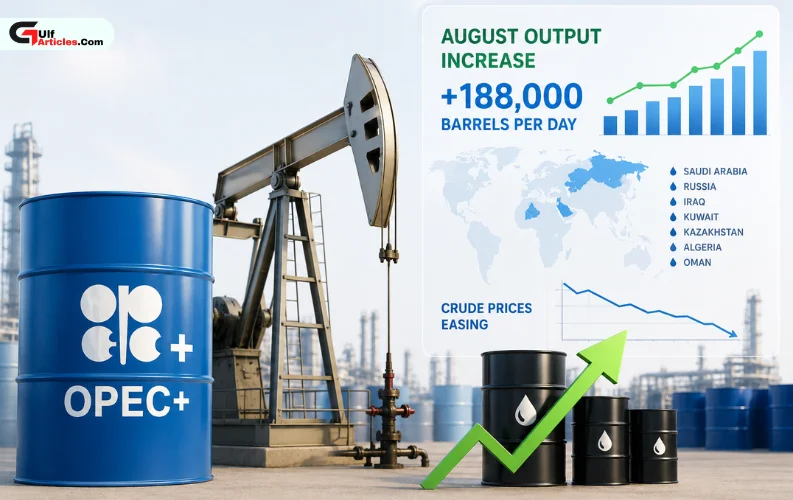
Seven members of the OPEC+ alliance have agreed to increase their combined crude oil production by 188,000 barrels per day (bpd) in August, extending the group's gradual supply expansion as global oil prices retreat to levels seen before the recent Middle East conflict.
The decision marks the fifth consecutive monthly production increase under the alliance's strategy to unwind voluntary output cuts introduced in 2023. The agreement was reached during a virtual meeting involving Saudi Arabia, Russia, Iraq, Kuwait, Kazakhstan, Algeria, and Oman.
Saudi Arabia and Russia will contribute the largest share of the increase, with each country adding 62,000 barrels per day to global supply next month.
In a joint statement, the participating countries reaffirmed their commitment to maintaining market stability while emphasizing that future production decisions will remain dependent on evolving global demand and supply conditions.
"The countries will continue to monitor and assess market conditions and reaffirm the importance of adopting a cautious approach to support market stability," the group said.
The production increase comes as international crude prices continue to decline. Brent crude was trading below $72 per barrel, while West Texas Intermediate (WTI) hovered near $68 per barrel, reflecting a sharp retreat from the highs recorded during the Middle East conflict earlier this year.
Oil prices have softened as geopolitical tensions eased following progress in regional negotiations and the gradual restoration of shipping activity through the Strait of Hormuz, one of the world's most important energy trade routes. Although maritime traffic has improved, shipping volumes remain below pre-conflict levels, and regional security concerns continue to influence market sentiment.
Analysts note that actual production has remained below official OPEC+ quotas during recent months because logistical disruptions limited exports from Gulf producers. As transportation routes reopen, previously stored crude is gradually returning to the market, increasing available supply and placing additional downward pressure on prices.
Despite the improving outlook, industry experts expect the recovery in Gulf oil production to remain gradual. Several market forecasts suggest full production capacity may not be restored until 2027, while the economic effects of higher energy costs are expected to persist in many regions.
OPEC+ also indicated that it retains the flexibility to pause, slow, or reverse production increases should market conditions deteriorate. The alliance is scheduled to review output policy again at its next meeting on August 2.
The latest decision highlights OPEC+'s continued effort to balance global supply with changing demand while supporting stability in an energy market still adjusting to geopolitical uncertainty and shifting economic conditions.
You may also like that news:-













Comments 0
No comments yet. Be the first to share your thoughts.
Leave a comment
Your email is never published. All fields are required.