

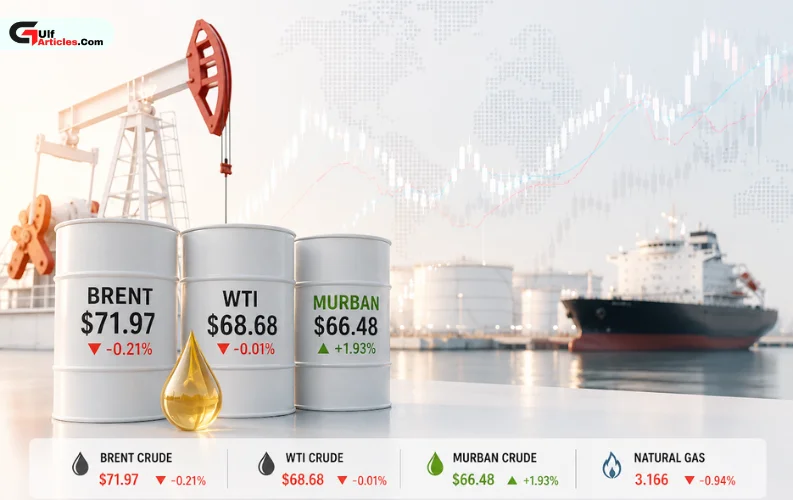
Global oil prices traded with little movement during Asian trading on Monday as easing geopolitical tensions in the Middle East offset expectations of firm seasonal fuel demand. While benchmark crude prices remained range-bound, Abu Dhabi's Murban crude stood out by posting notable gains amid sustained buying from Asian refiners.
According to market data recorded around 11:37 a.m. JST, Brent crude fell 15 cents (0.21%) to $71.97 per barrel, while U.S. West Texas Intermediate (WTI) edged down 1 cent (0.01%) to $68.68 per barrel. In contrast, Murban crude, Abu Dhabi's flagship export grade, climbed 1.93% to $66.48 per barrel, outperforming other major crude benchmarks. Meanwhile, natural gas futures slipped 0.94% to 3.166.
Geopolitical Risk Premium Continues to Fade
Oil markets have largely moved past the geopolitical premium that briefly lifted prices following heightened tensions in the Middle East last month.
Concerns surrounding potential disruptions after military developments involving Iran, Israel, and the United States had pushed crude prices higher, particularly due to fears over shipping through the Strait of Hormuz. However, uninterrupted oil exports from Gulf producers have eased concerns about immediate supply disruptions, allowing prices to stabilize.
Although geopolitical risks remain present, traders believe the likelihood of a major supply shock has declined for now.
OPEC+ Maintains Measured Production Strategy
The Organization of the Petroleum Exporting Countries and its allies (OPEC+) continue to follow a gradual production increase strategy aimed at balancing global supply and demand.
Market participants are also monitoring compliance among member countries while awaiting further guidance on future production targets. Analysts say the alliance's cautious approach has helped prevent sharp price swings despite ongoing geopolitical uncertainty.
Murban Crude Emerges as Market Leader
Unlike Brent and WTI, Murban crude posted the strongest gains among major oil benchmarks.
The benchmark has benefited from robust physical demand from Asian refiners preparing for the summer driving season, traditionally a period of higher fuel consumption across the region.
Energy analysts also attribute Murban's resilience to its growing importance as a regional pricing benchmark since the launch of its futures contract in Abu Dhabi, offering Asian buyers an increasingly attractive alternative to traditional global crude references.
Markets Await Fresh Economic and Supply Signals
Investors are now looking ahead to several key events expected to influence oil prices this week.
Among the most closely watched developments are fresh U.S. crude inventory data, upcoming economic indicators from China and the United States that could provide insight into global fuel demand, and any policy signals from OPEC+ regarding future production adjustments.
At the same time, market participants continue monitoring geopolitical developments in the Middle East for any signs that could impact shipping routes or crude production.
Market Outlook
Despite recent volatility, crude oil markets have returned to a relatively balanced trading range.
Brent continues to trade below the $72-per-barrel mark as healthy seasonal demand is largely offset by stable global supplies and easing geopolitical concerns. Analysts expect upcoming inventory reports, macroeconomic data, and OPEC+ decisions to provide the next major direction for global energy markets.
You may also like that news:-















Comments 0
No comments yet. Be the first to share your thoughts.
Leave a comment
Your email is never published. All fields are required.