

When business leaders discuss growth, the conversation often revolves around increasing revenue, expanding into new markets, attracting customers, launching products, or investing in innovation. These are visible and measurable drivers of growth, making them natural areas of focus for executives and entrepreneurs alike. However, many organizations overlook a less obvious factor that can have an equally significant impact on long-term success: the hidden costs embedded within everyday business operations.
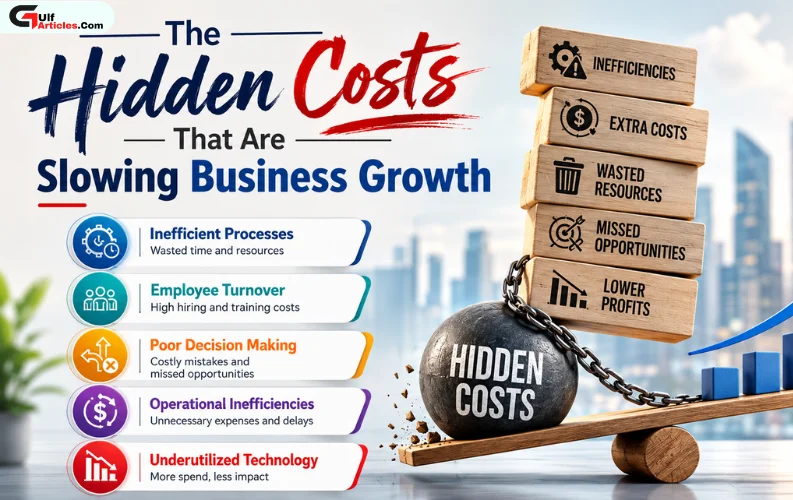
Unlike direct expenses such as salaries, rent, or marketing budgets, hidden costs are rarely identified on a financial statement under a single category. They accumulate gradually through inefficient processes, poor communication, outdated systems, high employee turnover, ineffective decision-making, and operational bottlenecks. Individually, these issues may appear manageable. Collectively, they can quietly erode profitability, reduce productivity, and limit an organization's ability to scale.
For businesses operating in increasingly competitive markets, identifying and addressing these hidden costs can be the difference between sustainable growth and stagnation. In many cases, organizations do not need to work harder or invest significantly more capital to accelerate growth. Instead, they need to eliminate the obstacles that are already slowing them down.
Why Hidden Costs Are Often Overlooked
One of the biggest challenges with hidden costs is that they rarely attract immediate attention. Unlike a major investment or a sudden increase in operating expenses, these costs often develop gradually over time. Because they are dispersed across different departments and functions, they can remain unnoticed for years.
Many organizations become accustomed to inefficient practices simply because they have always operated that way. Processes that once worked effectively may become outdated as businesses grow, technologies evolve, and customer expectations change. What begins as a minor inefficiency can eventually become a significant barrier to performance.
Leaders frequently focus on increasing sales and generating new opportunities while assuming that existing operations are functioning efficiently. As a result, substantial growth potential remains locked within the organization itself.
Understanding where these hidden costs originate is the first step toward unlocking greater efficiency and profitability.
The Cost of Inefficient Processes
Every business relies on processes to deliver products, services, and customer experiences. When those processes are inefficient, productivity suffers.
Many organizations continue to rely on manual workflows, duplicated tasks, excessive approvals, and outdated procedures that consume valuable time and resources. Employees often spend hours performing activities that could be simplified, automated, or eliminated entirely.
While a single inefficient process may appear insignificant, the cumulative impact across an organization can be substantial. Delays in communication, repeated data entry, unnecessary administrative tasks, and fragmented workflows all contribute to higher operating costs and reduced output.
Businesses that regularly review and optimize internal processes often discover opportunities to improve productivity without increasing headcount or spending.
Operational efficiency is not simply about reducing costs—it is about creating capacity for growth.
Poor Communication Can Be Expensive
Communication is one of the most underestimated drivers of business performance. When information is not shared effectively, organizations experience delays, misunderstandings, duplicated effort, and missed opportunities.
Poor communication can affect every level of a business. Employees may lack clarity regarding priorities. Departments may operate in isolation. Projects may take longer than expected due to unclear responsibilities or conflicting objectives.
The financial consequences can be significant. Missed deadlines, customer dissatisfaction, rework, and reduced productivity all carry costs that are often difficult to measure but impossible to ignore.
Organizations that foster transparent communication and encourage collaboration are typically better positioned to make decisions quickly and execute strategies effectively.
As businesses grow, communication systems become increasingly important. What works for a small team often becomes inadequate as complexity increases.
Employee Turnover and the Cost of Replacing Talent
Employee turnover is frequently viewed as a human resources issue, but it is also a major financial concern.
When experienced employees leave, businesses incur far more costs than recruitment expenses alone. Organizations must invest time and resources in hiring, onboarding, training, and integrating new team members. Productivity often declines during the transition period, while institutional knowledge and customer relationships may be lost.
The impact can be especially severe in specialized roles where expertise takes years to develop.
High turnover rates often indicate deeper organizational issues, including poor leadership, limited career development opportunities, inadequate workplace culture, or employee burnout. Addressing these root causes can improve retention while reducing the substantial costs associated with constant hiring.
Businesses that invest in employee engagement, professional development, and workplace culture often experience stronger performance and lower turnover over the long term.
The Hidden Price of Slow Decision-Making
In fast-moving markets, speed matters. Organizations that take too long to make decisions often miss opportunities, delay innovation, and struggle to respond to changing customer needs.
Many businesses unintentionally create decision-making bottlenecks through excessive bureaucracy, unclear authority structures, or overly complex approval processes. While these systems are often designed to reduce risk, they can ultimately hinder growth.
Slow decision-making affects more than internal efficiency. It can delay product launches, reduce customer responsiveness, and limit an organization's ability to adapt to market changes.
Companies that empower leaders, clarify responsibilities, and streamline decision-making processes are often more agile and better positioned to capitalize on opportunities.
In today's business environment, responsiveness has become a competitive advantage.
Outdated Technology Is Holding Many Businesses Back
Technology investments are often evaluated based on their upfront cost, but the cost of not modernizing can be even greater.
Many organizations continue to operate with outdated systems that limit productivity, create inefficiencies, and increase maintenance requirements. Employees may spend unnecessary time navigating disconnected platforms, manually transferring information, or working around technical limitations.
These inefficiencies not only reduce productivity but also affect customer experiences and decision-making quality.
Modern technology solutions can improve visibility, automate repetitive tasks, strengthen collaboration, and provide valuable insights into business performance. While upgrading systems requires investment, failing to do so often results in higher long-term costs.
Businesses that embrace digital transformation are frequently able to improve efficiency while creating a stronger foundation for future growth.
Customer Churn Is More Expensive Than Most Companies Realize
Acquiring new customers requires significant investment. Marketing campaigns, sales efforts, promotional activities, and onboarding processes all contribute to customer acquisition costs.
When customers leave, businesses lose not only current revenue but also future opportunities. In many cases, replacing an existing customer costs substantially more than retaining one.
Despite this reality, many organizations focus more attention on acquisition than retention.
Customer churn often results from preventable issues such as poor service, inconsistent experiences, inadequate communication, or failure to meet evolving expectations. Businesses that prioritize customer satisfaction and relationship management often achieve stronger long-term growth at a lower overall cost.
Retaining customers is not simply a customer service objective—it is a strategic growth initiative.
Meetings, Complexity, and Lost Productivity
Most organizations recognize the importance of collaboration, but excessive meetings and unnecessary complexity can become significant drains on productivity.
Employees frequently spend large portions of their workweek attending meetings that lack clear objectives, actionable outcomes, or direct relevance to their responsibilities. While each meeting may seem harmless, the cumulative impact across an organization can be substantial.
Similarly, overly complex structures, procedures, and reporting requirements often consume time without generating meaningful value.
Businesses that simplify operations and create more focused working environments often experience noticeable improvements in efficiency and employee engagement.
Sometimes growth is not limited by a lack of opportunity but by the amount of time wasted on low-value activities.
The Most Common Hidden Costs Limiting Growth
While every organization faces unique challenges, several hidden costs appear consistently across industries:
Hidden Growth Killers
-
Inefficient operational processes
-
Poor internal communication
-
High employee turnover
-
Slow decision-making structures
-
Outdated technology systems
-
Customer churn
-
Excessive administrative work
-
Lack of workforce training
-
Departmental silos
-
Poor data management
-
Unnecessary meetings
-
Weak performance measurement systems
Individually, these issues may seem manageable. Together, they can significantly reduce an organization's ability to grow.
Why Growth Often Starts With Optimization
Many businesses assume growth requires major investments, aggressive expansion strategies, or large-scale transformation initiatives. While those approaches can be effective, some of the greatest growth opportunities exist within existing operations.
Organizations that identify and eliminate hidden costs often unlock resources, improve productivity, strengthen profitability, and create greater capacity for innovation.
Optimization does not necessarily require dramatic change. In many cases, small improvements across multiple areas generate substantial cumulative benefits.
Leaders who regularly evaluate processes, systems, communication practices, and organizational structures are often able to identify barriers that have quietly limited performance for years.
Looking Ahead
Business growth is not determined solely by how much revenue an organization generates. It is also influenced by how effectively resources are utilized, decisions are made, employees are supported, and customers are retained.
The hidden costs that exist within many organizations rarely attract attention because they operate quietly in the background. Yet their impact can be profound. They reduce efficiency, increase expenses, slow innovation, and limit growth potential.
As competition continues to intensify, businesses cannot afford to ignore these challenges. The organizations that achieve sustainable success will be those willing to look beyond obvious expenses and address the operational inefficiencies that quietly undermine performance.
In many cases, the fastest path to growth is not finding new opportunities. It is removing the obstacles that are already standing in the way.
Read more: