

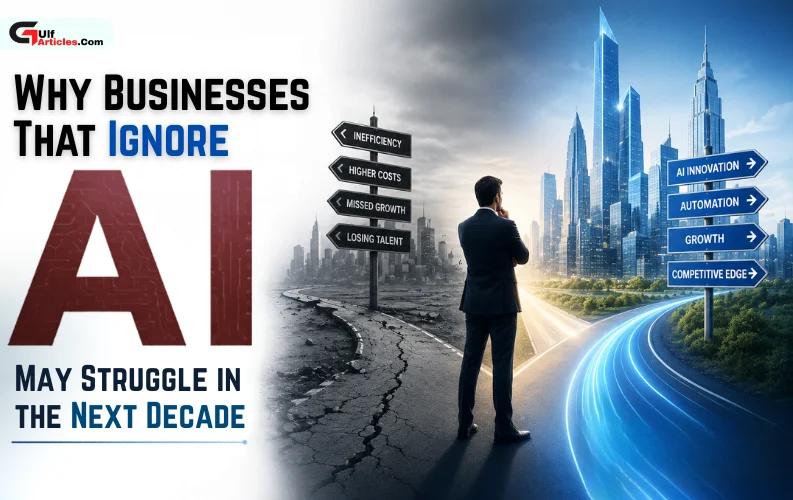
Artificial intelligence is no longer a futuristic concept reserved for technology giants or research laboratories. It is rapidly becoming one of the most influential forces shaping how businesses operate, compete, communicate, and grow across nearly every industry.
From customer service and marketing to finance, healthcare, logistics, and manufacturing, AI is changing the speed and scale at which companies make decisions and deliver results. What once seemed like an optional innovation is now evolving into a fundamental business necessity.
As the global economy becomes increasingly digital and data-driven, businesses that hesitate to adapt may find themselves struggling to remain competitive in the years ahead.
The next decade is likely to separate companies that successfully integrate AI into their operations from those that continue relying entirely on traditional systems and outdated business models.
AI Is Reshaping the Competitive Landscape
Every major technological shift changes the business environment, but artificial intelligence is transforming industries at a pace few technologies have achieved before.
Companies today are using AI to:
- Improve operational efficiency
- Analyze customer behavior
- Automate repetitive tasks
- Strengthen decision-making
- Enhance personalization
- Predict market trends
- Reduce operational costs
Businesses adopting these technologies are often able to move faster, respond more accurately to customer needs, and scale more efficiently than competitors still relying heavily on manual processes.
This growing gap between AI-enabled companies and traditional businesses is expected to widen significantly over the next decade.
Organizations that fail to evolve may struggle not because they lack experience or resources, but because they are operating at a slower speed in an increasingly fast-moving economy.
Customer Expectations Are Changing Rapidly
Modern consumers now expect faster, smarter, and more personalized experiences.
AI is already influencing how people interact with businesses through:
- Personalized recommendations
- Instant customer support
- Predictive services
- Smart search systems
- Automated communication
- Data-driven user experiences
Consumers are becoming accustomed to businesses that understand their preferences and respond quickly to their needs. Companies unable to meet these expectations risk appearing outdated or inefficient compared to competitors using intelligent digital systems.
This shift is especially visible in industries such as e-commerce, banking, entertainment, travel, healthcare, and digital services where personalization and convenience increasingly influence customer loyalty.
Businesses that ignore AI may struggle to maintain customer engagement in markets where speed and user experience have become major competitive advantages.
AI Is Improving Productivity at Scale
One of the most significant advantages AI offers businesses is productivity enhancement.
Many organizations still spend enormous amounts of time on repetitive administrative tasks, manual data processing, scheduling, reporting, and operational workflows that AI systems can now perform far more efficiently.
AI tools are helping companies:
- Save time
- Reduce human error
- Streamline operations
- Increase output
- Improve workflow efficiency
This does not necessarily mean replacing human employees entirely. In many cases, AI is being used to support teams by allowing professionals to focus on more strategic, creative, and high-value work.
Companies that resist AI adoption may eventually face operational disadvantages compared to competitors capable of delivering results faster and more efficiently.
Over time, productivity gaps can directly influence profitability, scalability, and long-term market relevance.
Data Is Becoming One of the Most Valuable Business Assets
Modern businesses generate enormous amounts of data every day. However, data alone holds little value without the ability to analyze and apply it effectively.
Artificial intelligence is transforming how organizations interpret information and make decisions.
AI-powered systems can identify patterns, predict trends, and provide insights at a scale impossible through manual analysis alone. Businesses are increasingly using AI to improve:
- Market forecasting
- Customer insights
- Financial analysis
- Inventory management
- Risk assessment
- Strategic planning
Organizations that continue relying solely on traditional analysis methods may struggle to compete against companies capable of making faster and more informed decisions through intelligent systems.
In the coming decade, data-driven decision-making is likely to become one of the strongest indicators of business competitiveness.
AI Is Influencing Innovation Across Industries
Innovation is becoming increasingly connected to artificial intelligence.
Businesses are using AI not only to optimize existing operations but also to develop entirely new products, services, and business models.
Industries such as healthcare, education, finance, transportation, retail, cybersecurity, and media are already experiencing major transformation through AI-driven innovation.
Companies ignoring these developments may risk missing emerging market opportunities and falling behind competitors embracing technological change.
History has shown that businesses slow to adapt during major technological transitions often struggle to recover market relevance later.
The rise of digital commerce, cloud computing, and mobile technology already demonstrated how quickly industries can change. AI may reshape business even more dramatically over the next decade.
The Workforce Is Changing Alongside Technology
Artificial intelligence is also changing workforce expectations and professional environments.
Modern employees increasingly expect businesses to operate with updated digital tools and efficient systems. Companies that continue relying heavily on outdated processes may struggle to attract younger, digitally skilled talent.
At the same time, AI is creating demand for professionals who can combine:
- Technology awareness
- Strategic thinking
- Creativity
- Problem-solving
- Digital adaptability
Organizations that embrace AI thoughtfully are often better positioned to build future-ready teams capable of adapting to evolving market conditions.
Businesses that ignore these shifts may find themselves facing both operational inefficiencies and talent retention challenges in the years ahead.
AI Adoption Is No Longer Limited to Large Corporations
One common misconception is that artificial intelligence is only accessible to large multinational companies with massive budgets.
In reality, AI tools are becoming increasingly affordable and accessible for businesses of all sizes.
Small and mid-sized companies now have access to AI-powered:
- Marketing tools
- Customer service systems
- Analytics platforms
- Content optimization tools
- Productivity software
- Automation systems
This accessibility means businesses no longer need enormous infrastructure to begin integrating AI into their operations.
As adoption becomes more widespread, companies choosing to avoid AI entirely may face growing disadvantages even within smaller market segments.
Human Creativity Will Still Matter
Despite concerns surrounding automation, the future of business is unlikely to become entirely machine-driven.
Human creativity, emotional intelligence, strategic leadership, and relationship-building will continue playing critical roles in successful organizations. The businesses most likely to thrive are not necessarily those replacing humans with AI, but those learning how to combine human strengths with intelligent technology effectively.
AI works best when used to enhance decision-making, productivity, and innovation rather than eliminate human value entirely.
Companies that understand this balance are more likely to create sustainable long-term growth.
The Next Decade Will Reward Adaptability
The business landscape of the next decade will likely belong to organizations capable of adapting quickly to technological change.
Artificial intelligence is no longer simply an emerging trend. It is becoming part of the foundational infrastructure shaping modern business operations worldwide.
Companies that remain open to innovation, invest in digital transformation, and embrace AI strategically are positioning themselves for stronger competitiveness and long-term relevance.
Businesses that ignore these changes may not disappear immediately, but over time they risk becoming slower, less efficient, and less aligned with evolving customer expectations and market realities.
The future economy will increasingly reward adaptability, digital intelligence, and innovation-driven thinking.
For businesses preparing for the next decade, the real question may no longer be whether AI matters, but how quickly organizations are willing to evolve alongside it.
Frequently Asked Questions
Why is AI important for businesses?
AI helps businesses improve efficiency, automate tasks, analyze data, personalize customer experiences, and make faster strategic decisions.
Can small businesses benefit from AI?
Yes. Modern AI tools are becoming more affordable and accessible, allowing small businesses to improve productivity, marketing, customer service, and operations.
Will AI replace human jobs completely?
AI is expected to automate certain repetitive tasks, but human creativity, leadership, emotional intelligence, and strategic thinking will continue to remain highly valuable.
What industries are being most affected by AI?
Industries such as healthcare, finance, retail, logistics, education, marketing, media, and technology are experiencing significant transformation through AI adoption.
Read more:
















Comments 0
No comments yet. Be the first to share your thoughts.
Leave a comment
Your email is never published. All fields are required.