
whatsapp

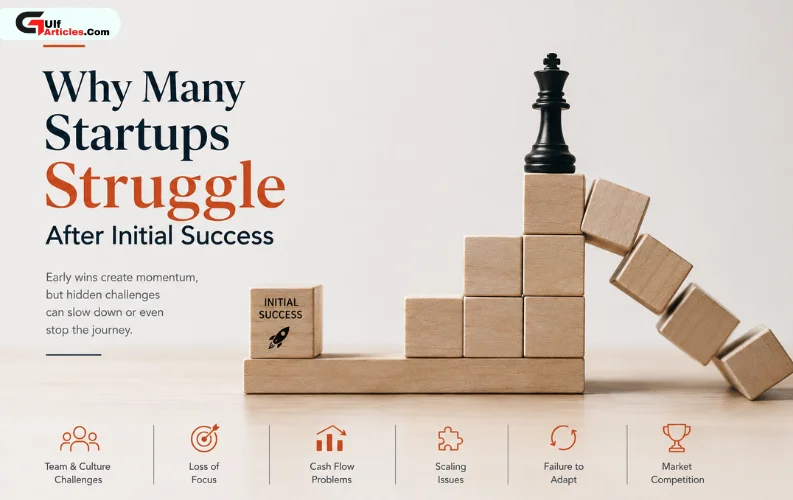
Why Many Startups Struggle After Initial Success

  • 0
  • 579
/media/GA_QPJEDbR._1.webp © Image Copyrights Title

Early success can be one of the most defining moments in a startup’s journey. A product gains traction, customers respond positively, revenue begins to grow, and the business starts to build visibility. At this stage, confidence increases, not just within the organization, but also among investors, partners, and the market.

However, this phase often creates a false sense of stability.

Many startups that achieve initial success struggle to maintain momentum over time. Growth slows, operational challenges increase, and the same strategies that worked in the early stage begin to lose effectiveness.

The issue is not the lack of potential. It is the transition from early traction to sustainable scale, a phase that requires a fundamentally different approach.

The Nature of Early Success

In the early stages, startups operate with speed and flexibility.

Decisions are made quickly, teams are small, and the focus is clear. Founders are deeply involved in every aspect of the business, and there is a strong alignment between product, market, and execution.

This environment enables rapid progress.

However, early success is often driven by:

  • A strong initial product-market fit
  • Limited competition in the early phase
  • High levels of founder involvement
  • Focused and simplified operations

While these factors create momentum, they do not automatically scale.

The Shift from Traction to Scale

As a startup grows, the nature of the business changes.

Operations become more complex, teams expand, and customer expectations evolve. What once worked as an informal and flexible approach begins to require structure and consistency.

This transition introduces new challenges:

  • Managing larger teams
  • Maintaining product quality at scale
  • Aligning strategy across departments
  • Balancing growth with operational efficiency

Startups that fail to adapt to this shift often struggle, not because they lack opportunity, but because they lack systems to support growth.

Where Startups Begin to Lose Momentum

The challenges that emerge after initial success are rarely sudden. They develop gradually, often unnoticed until performance begins to decline.

Some of the most common patterns include:

  • Overexpansion without operational readiness
  • Loss of focus as priorities multiply
  • Increasing costs without proportional revenue growth
  • Declining product differentiation as competition increases

These issues are interconnected and often reinforce each other.

The Problem of Overconfidence

Early success can lead to overconfidence.

Founders and teams may assume that initial growth validates all aspects of the business, leading to decisions that are not fully grounded in data or long-term strategy.

This can result in:

  • Aggressive expansion into new markets
  • Launching additional products without clear demand
  • Scaling teams faster than necessary

While confidence is important, it must be balanced with continuous evaluation.

Success at one stage does not guarantee success at the next.

Operational Complexity Increases Faster Than Expected

One of the most underestimated challenges is operational complexity.

As startups grow, processes that were once simple become difficult to manage. Communication gaps emerge, decision-making slows down, and inefficiencies begin to affect performance.

Without structured systems, complexity can lead to:

  • Delayed execution
  • Reduced accountability
  • Inconsistent customer experience

Managing this complexity requires a shift from informal processes to defined operational frameworks.

The Changing Nature of Competition

In the early stages, startups often benefit from being first movers or operating in less crowded markets.

As they grow, competition intensifies.

New entrants replicate successful models, established players respond more aggressively, and differentiation becomes harder to maintain.

To remain competitive, startups must:

  • Continuously refine their value proposition
  • Invest in product development
  • Strengthen customer relationships

Relying solely on early advantages is rarely sufficient in a competitive market.

Financial Discipline Becomes Critical

Initial success can sometimes mask underlying financial inefficiencies.

As the business scales, these inefficiencies become more visible.

Startups that do not establish financial discipline early may face:

  • Increasing burn rates
  • Pressure from investors
  • Limited flexibility during market changes

Sustainable growth requires:

  • Clear revenue strategies
  • Cost control mechanisms
  • Strong unit economics

Without these, growth can become difficult to maintain.

Common Post-Success Challenges

While each startup’s journey is different, certain challenges consistently appear after early success:

  • Scaling teams faster than processes can support
  • Expanding into new markets without sufficient understanding
  • Losing alignment between leadership and execution
  • Underestimating the importance of operational structure
  • Failing to adapt strategies as the business evolves

These challenges are not failures in themselves but they require timely recognition and response.

The Role of Leadership in Sustaining Growth

As startups move beyond the early stage, leadership responsibilities evolve.

Founders must transition from hands-on operators to strategic leaders who can:

  • Build scalable systems
  • Delegate effectively
  • Maintain organizational alignment

This transition is often difficult, but essential.

Leadership at this stage is less about direct involvement and more about enabling consistent execution across the organization.

Conclusion

Initial success is an important milestone, but it is not a guarantee of long-term sustainability.

The transition from early growth to stable scale introduces new challenges that require different capabilities, structures, and strategies.

Startups that succeed beyond this phase are those that:

  • Recognize the limits of early-stage approaches
  • Build systems to support complexity
  • Maintain discipline in both operations and finance

Ultimately, success is not defined by how quickly a startup grows, but by how effectively it adapts as it grows.


Read more:
Commnets 0
Leave A Comment

Related Posts
© The Reality of Leadership: Balancing Vision with Execution

The Reality of Leadership: Balancing Vision with Execution

Leadership is often framed around vision, the ability to anticipate change, define direction, and inspire others toward a future that does not yet exist. While this remains an essential attribute, it ...

  • 6593
© What Kills Profitable Businesses After the First Three Years

What Kills Profitable Businesses After the First Three Years

For many founders, the third year of business is quietly reassuring. The company has survived its most fragile phase. Revenue is consistent. Clients return. Cash is moving, even if imperfectly. From t...

  • 5897
© When Growth Becomes the Risk: A Reality Check for Businesses

When Growth Becomes the Risk: A Reality Check for Businesses

For most businesses, growth is framed as a solution. More customers, higher revenue, wider reach—these are the signals founders are taught to chase. Growth promises security, validation, and relevance...

  • 7712
© Entrepreneurship in the GCC: Where the Real Opportunities Lie

Entrepreneurship in the GCC: Where the Real Opportunities Lie

Entrepreneurship in the Gulf Cooperation Council (GCC) is no longer defined by isolated success stories or short-term market booms. Over the past decade, the region has undergone a structural shift in...

  • 8010
© Small Business Opportunities in the UAE and Saudi Arabia

Small Business Opportunities in the UAE and Saudi Arabia

The United Arab Emirates and Saudi Arabia occupy a unique position in the global business landscape. Both countries combine strong purchasing power with ambitious national development agendas, creatin...

  • 558
© Why Small Businesses Struggle to Scale (And Where They Break Down)

Why Small Businesses Struggle to Scale (And Where They Break Down)

For many small businesses, the most difficult phase does not arrive at the beginning. It arrives after early success. Customers increase, revenue begins to stabilise, and visibility improves. From the...

  • 641
© Business Opportunities Across the Gulf Region: A Practical Perspective

Business Opportunities Across the Gulf Region: A Practical Perspective

The Gulf region has emerged as one of the world’s most strategically positioned business environments. Over the last two decades, Gulf economies have moved beyond traditional dependence on hydrocarbon...

  • 816
© What Are Some Great Business Ideas That Are Easy-ish Entries?

What Are Some Great Business Ideas That Are Easy-ish Entries?

Many aspiring entrepreneurs are eager to start a business but are often discouraged by high startup costs, complex legal processes, or technical skill requirements. The good news is that not all busin...

  • 759
© Corporate Culture in the Middle East: Where Tradition Meets Modern Business Realities

Corporate Culture in the Middle East: Where Tradition Meets Modern Business Realities

Corporate culture in the Middle East is shaped by a unique blend of deep-rooted traditions, emerging economic ambitions, and the region’s growing integration with the global business ecosystem. This i...

  • 876
© Why Diversity and Inclusion Are Good for Business Growth

Why Diversity and Inclusion Are Good for Business Growth

For years, “diversity” and “inclusion” were seen by some companies as checkboxes, nice-sounding words added to annual reports or HR policies. But by 2026, the conversation has evolved. Forward-looking...

  • 733
© The Future of Shari’ah-Compliant Finance in Global Markets

The Future of Shari’ah-Compliant Finance in Global Markets

Shari’ah-compliant finance, grounded in the principles of risk-sharing, asset-backing, avoidance of riba (interest), and excessive uncertainty (gharar), has moved far beyond its early niche. What bega...

  • 1322
© The Business Equation: Balancing Profit, People, and Purpose in a Changing World

The Business Equation: Balancing Profit, People, and Purpose in a Changing World

In every generation, business leaders face a moment when the rules of success quietly change. For decades, profit was the ultimate scoreboard. If the numbers were strong, the business was considered h...

  • 750
© Why Personal Branding Is Now a Business Strategy

Why Personal Branding Is Now a Business Strategy

Corporate branding was how companies operated for decades. A strong logo, a catchy slogan, and expensive advertising campaigns were enough to drive loyalty. Coca-Cola, Nike, Apple, and Microsoft all p...

  • 937
© What Unique Business Ideas Are Not Yet Implemented?

What Unique Business Ideas Are Not Yet Implemented?

Innovation is the heart of entrepreneurship. While many business ideas revolve around improving existing models or offering known services in new ways, the most powerful breakthroughs often come from ...

  • 1213
© What Are Some Profitable Business Ideas for a Small Shop?

What Are Some Profitable Business Ideas for a Small Shop?

In a business world increasingly dominated by large-scale retailers and online giants, one might assume that small shops are on their way out. The reality, however, is quite the opposite. Small, thoug...

  • 1239
© What Is the Easiest Way to Come Up with a Business Idea?

What Is the Easiest Way to Come Up with a Business Idea?

Many aspiring entrepreneurs wonder how to come up with a strong, viable business idea, something original yet achievable. In reality, the best ideas often emerge from personal experiences, common frus...

  • 1352
© What Are the New 12 Unique Online Business Ideas?

What Are the New 12 Unique Online Business Ideas?

As digital infrastructure continues to evolve and global connectivity grows stronger, online business opportunities have become more dynamic and diverse than ever before. In the post-pandemic digital ...

  • 1532
© What Are Some Small Business Ideas While Doing a Job?

What Are Some Small Business Ideas While Doing a Job?

In today’s fast-paced, financially demanding world, relying on a single income stream is no longer a secure strategy. Whether you're trying to pay off debt, save for future goals, or simply pursue a p...

  • 1282
© How to Find and Choose the Right Small Business Idea for You?

How to Find and Choose the Right Small Business Idea for You?

In the modern entrepreneurial landscape, finding the right small business idea is often the first and most crucial step toward long-term success. Many people aspire to start a business but struggle wi...

  • 1258
© Inside the Numbers: Estimating the Total Companies in the World in 2025

Inside the Numbers: Estimating the Total Companies in the World in 2025

In today's hyper-connected global economy, companies of all shapes and sizes power the engines of innovation, employment, and economic development. From microenterprises operating out of rural village...

  • 6332