
whatsapp

Building a Business While Managing Multiple Roles: A Practical Perspective

  • 0
  • 286
/media/GA_Kn5Plqr._5.webp © Image Copyrights Title

For many entrepreneurs especially women building a business is rarely a single-focus journey. It often exists alongside multiple responsibilities: managing a household, raising a family, maintaining personal commitments, and navigating professional expectations. Unlike traditional business narratives that emphasize singular focus and uninterrupted scaling, the reality for many founders is far more layered.

This complexity does not necessarily limit success, but it changes how success is built.

In 2026, the conversation around entrepreneurship is evolving. It is no longer just about rapid growth or aggressive expansion. It is increasingly about sustainability, balance, and intentional decision-making particularly for those managing multiple roles simultaneously.

The Reality of Multi-Role Entrepreneurship

Entrepreneurs who manage multiple roles operate within a different framework.

Their time is divided, their priorities are dynamic, and their decision-making often involves trade-offs that go beyond business metrics. This creates a unique set of challenges that are not always visible in traditional business discussions.

Unlike founders who can dedicate all their time to business operations, multi-role entrepreneurs must constantly balance:

  • Immediate business needs
  • Personal and family responsibilities
  • Long-term professional goals

This balancing act requires a level of discipline and adaptability that goes beyond standard business strategy.

Time Is Not the Constraint Energy and Focus Are

One of the most common misconceptions is that the primary challenge is a lack of time.

In reality, the greater challenge is managing energy and focus.

When responsibilities are spread across different areas, maintaining consistent productivity becomes more complex. Switching between roles business owner, parent, professional requires mental adjustment, which can reduce efficiency if not managed properly.

Effective entrepreneurs in this situation do not attempt to do everything at once. Instead, they structure their work in a way that allows them to focus on high-impact tasks during limited but dedicated periods.

The Importance of Structured Flexibility

Flexibility is often seen as an advantage, but without structure, it can lead to inconsistency.

Entrepreneurs managing multiple roles benefit from what can be described as structured flexibility a system that allows adaptability without losing direction.

This includes:

  • Defining clear work blocks for focused business activities
  • Setting realistic expectations for daily output
  • Aligning business goals with personal schedules

Rather than forcing rigid routines, this approach creates a balance between discipline and adaptability.

Decision-Making Becomes More Intentional

When time and resources are limited, every decision carries greater weight.

Multi-role entrepreneurs cannot afford to pursue every opportunity. They must evaluate decisions based on impact, feasibility, and alignment with their overall priorities.

This leads to a more intentional approach to:

  • Business expansion
  • Client or project selection
  • Investment of time and resources

While this may slow down certain aspects of growth, it often results in more sustainable outcomes.

Key Challenges Faced While Managing Multiple Roles

Despite the advantages of adaptability and discipline, there are consistent challenges that entrepreneurs face in this situation:

  • Limited uninterrupted work time
    Making it difficult to engage in deep, focused tasks
  • Frequent context switching
    Reducing efficiency and increasing mental fatigue
  • Pressure to meet expectations across different roles
    Both personal and professional
  • Difficulty scaling operations quickly
    Due to time and resource constraints
  • Risk of burnout
    When boundaries between responsibilities are not clearly defined

Recognizing these challenges is essential for building effective strategies to manage them.

Building Systems Instead of Relying on Effort

Sustaining a business while managing multiple roles cannot rely on effort alone.

Systems become critical.

Instead of handling every task personally, entrepreneurs must create processes that allow the business to function independently. This includes automating routine tasks, delegating responsibilities, and standardizing workflows.

Over time, this reduces dependency on constant involvement and creates space for strategic thinking.

The Role of Support Structures

No entrepreneur operates entirely independently, especially when managing multiple roles.

Support systems both personal and professional play a significant role in maintaining balance.

These may include:

  • Delegation within the business
  • Family or household support
  • External services for operational tasks

Building a support structure allows entrepreneurs to focus on high-value activities rather than being overwhelmed by routine responsibilities.

Strategies That Help Maintain Balance

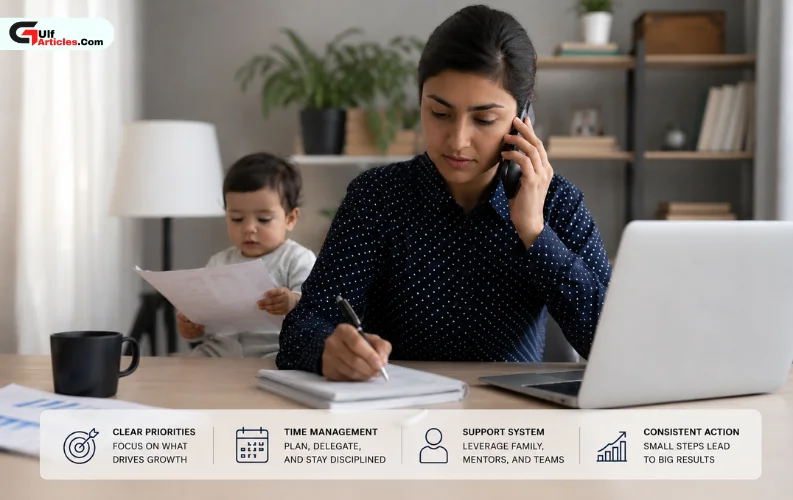
To manage both business and personal responsibilities effectively, entrepreneurs often rely on a set of practical strategies:

  • Prioritization of high-impact tasks
    Focusing on activities that directly contribute to business growth
  • Time blocking for focused work
    Allocating specific periods for uninterrupted tasks
  • Delegation and outsourcing
    Reducing workload by assigning tasks where possible
  • Setting clear boundaries
    Separating work time from personal time
  • Maintaining realistic growth expectations
    Scaling at a pace that aligns with available resources

These strategies are not about doing more they are about doing what matters most.

Redefining Success in a Multi-Role Context

Entrepreneurs managing multiple roles often redefine what success looks like.

Instead of measuring progress solely through rapid growth or financial metrics, they consider:

  • Sustainability of the business
  • Quality of work and relationships
  • Balance between personal and professional life

This perspective leads to a more holistic approach to entrepreneurship, where success is aligned with overall well-being rather than short-term outcomes.

Conclusion

Building a business while managing multiple roles is not a limitation, it is a different model of entrepreneurship.

It requires greater discipline, stronger prioritization, and more intentional decision-making. While the pace of growth may differ from traditional models, the outcomes can be equally strong, if not more sustainable.

In today’s evolving business environment, success is no longer defined by how quickly a business scales, but by how effectively it is built to endure.

Entrepreneurs who embrace this approach are not just managing multiple roles they are redefining how modern businesses are created and sustained.

Commnets 0
Leave A Comment

Related Posts
© Why Many Startups Struggle After Initial Success

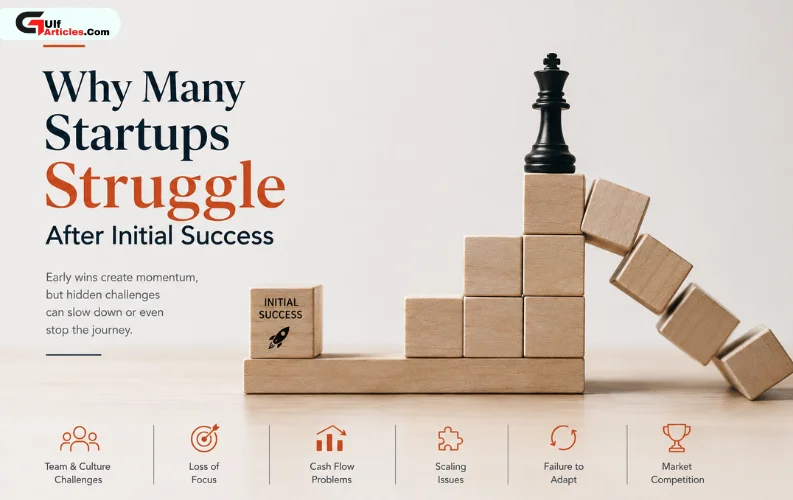
Why Many Startups Struggle After Initial Success

Early success can be one of the most defining moments in a startup’s journey. A product gains traction, customers respond positively, revenue begins to grow, and the business starts to build visibi...

  • 662
© The Reality of Leadership: Balancing Vision with Execution

The Reality of Leadership: Balancing Vision with Execution

Leadership is often framed around vision, the ability to anticipate change, define direction, and inspire others toward a future that does not yet exist. While this remains an essential attribute, it ...

  • 6673
© What Kills Profitable Businesses After the First Three Years

What Kills Profitable Businesses After the First Three Years

For many founders, the third year of business is quietly reassuring. The company has survived its most fragile phase. Revenue is consistent. Clients return. Cash is moving, even if imperfectly. From t...

  • 5964
© When Growth Becomes the Risk: A Reality Check for Businesses

When Growth Becomes the Risk: A Reality Check for Businesses

For most businesses, growth is framed as a solution. More customers, higher revenue, wider reach—these are the signals founders are taught to chase. Growth promises security, validation, and relevance...

  • 7772
© Entrepreneurship in the GCC: Where the Real Opportunities Lie

Entrepreneurship in the GCC: Where the Real Opportunities Lie

Entrepreneurship in the Gulf Cooperation Council (GCC) is no longer defined by isolated success stories or short-term market booms. Over the past decade, the region has undergone a structural shift in...

  • 8068
© Small Business Opportunities in the UAE and Saudi Arabia

Small Business Opportunities in the UAE and Saudi Arabia

The United Arab Emirates and Saudi Arabia occupy a unique position in the global business landscape. Both countries combine strong purchasing power with ambitious national development agendas, creatin...

  • 615
© Why Small Businesses Struggle to Scale (And Where They Break Down)

Why Small Businesses Struggle to Scale (And Where They Break Down)

For many small businesses, the most difficult phase does not arrive at the beginning. It arrives after early success. Customers increase, revenue begins to stabilise, and visibility improves. From the...

  • 696
© Business Opportunities Across the Gulf Region: A Practical Perspective

Business Opportunities Across the Gulf Region: A Practical Perspective

The Gulf region has emerged as one of the world’s most strategically positioned business environments. Over the last two decades, Gulf economies have moved beyond traditional dependence on hydrocarbon...

  • 867
© What Are Some Great Business Ideas That Are Easy-ish Entries?

What Are Some Great Business Ideas That Are Easy-ish Entries?

Many aspiring entrepreneurs are eager to start a business but are often discouraged by high startup costs, complex legal processes, or technical skill requirements. The good news is that not all busin...

  • 810
© Corporate Culture in the Middle East: Where Tradition Meets Modern Business Realities

Corporate Culture in the Middle East: Where Tradition Meets Modern Business Realities

Corporate culture in the Middle East is shaped by a unique blend of deep-rooted traditions, emerging economic ambitions, and the region’s growing integration with the global business ecosystem. This i...

  • 929
© Why Diversity and Inclusion Are Good for Business Growth

Why Diversity and Inclusion Are Good for Business Growth

For years, “diversity” and “inclusion” were seen by some companies as checkboxes, nice-sounding words added to annual reports or HR policies. But by 2026, the conversation has evolved. Forward-looking...

  • 774
© The Future of Shari’ah-Compliant Finance in Global Markets

The Future of Shari’ah-Compliant Finance in Global Markets

Shari’ah-compliant finance, grounded in the principles of risk-sharing, asset-backing, avoidance of riba (interest), and excessive uncertainty (gharar), has moved far beyond its early niche. What bega...

  • 1364
© The Business Equation: Balancing Profit, People, and Purpose in a Changing World

The Business Equation: Balancing Profit, People, and Purpose in a Changing World

In every generation, business leaders face a moment when the rules of success quietly change. For decades, profit was the ultimate scoreboard. If the numbers were strong, the business was considered h...

  • 797
© Why Personal Branding Is Now a Business Strategy

Why Personal Branding Is Now a Business Strategy

Corporate branding was how companies operated for decades. A strong logo, a catchy slogan, and expensive advertising campaigns were enough to drive loyalty. Coca-Cola, Nike, Apple, and Microsoft all p...

  • 982
© What Unique Business Ideas Are Not Yet Implemented?

What Unique Business Ideas Are Not Yet Implemented?

Innovation is the heart of entrepreneurship. While many business ideas revolve around improving existing models or offering known services in new ways, the most powerful breakthroughs often come from ...

  • 1257
© What Are Some Profitable Business Ideas for a Small Shop?

What Are Some Profitable Business Ideas for a Small Shop?

In a business world increasingly dominated by large-scale retailers and online giants, one might assume that small shops are on their way out. The reality, however, is quite the opposite. Small, thoug...

  • 1304
© What Is the Easiest Way to Come Up with a Business Idea?

What Is the Easiest Way to Come Up with a Business Idea?

Many aspiring entrepreneurs wonder how to come up with a strong, viable business idea, something original yet achievable. In reality, the best ideas often emerge from personal experiences, common frus...

  • 1397
© What Are the New 12 Unique Online Business Ideas?

What Are the New 12 Unique Online Business Ideas?

As digital infrastructure continues to evolve and global connectivity grows stronger, online business opportunities have become more dynamic and diverse than ever before. In the post-pandemic digital ...

  • 1576
© What Are Some Small Business Ideas While Doing a Job?

What Are Some Small Business Ideas While Doing a Job?

In today’s fast-paced, financially demanding world, relying on a single income stream is no longer a secure strategy. Whether you're trying to pay off debt, save for future goals, or simply pursue a p...

  • 1323
© How to Find and Choose the Right Small Business Idea for You?

How to Find and Choose the Right Small Business Idea for You?

In the modern entrepreneurial landscape, finding the right small business idea is often the first and most crucial step toward long-term success. Many people aspire to start a business but struggle wi...

  • 1291