

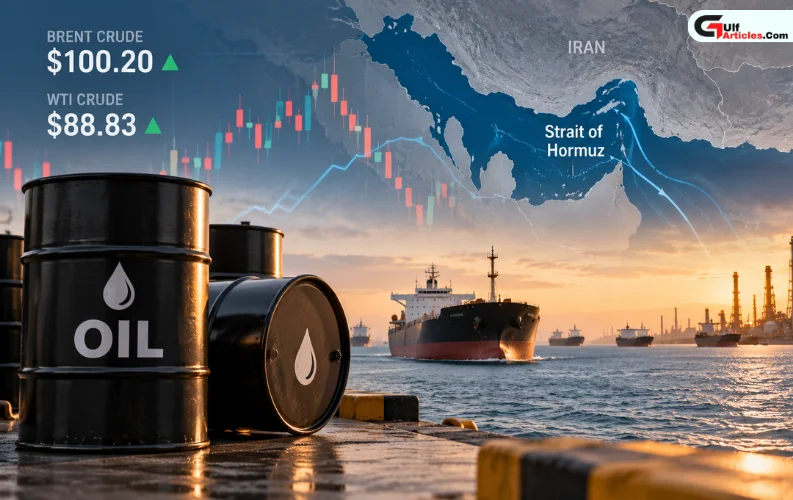
Oil prices slipped in Asian trading on Thursday, but traders said the decline reflects short-term positioning rather than a change in underlying supply risks tied to tensions in the Strait of Hormuz. Brent crude eased toward $95 a barrel, while US West Texas Intermediate (WTI) traded at $90.63 as of 9:38 a.m. in Tokyo. Murban crude was little changed at $100.85.
The pullback follows recent gains driven by escalating conflict in the Middle East and concerns over restricted oil flows through the Strait of Hormuz, a key global supply route.
Shipping disruptions persist
Market participants said physical oil flows through Hormuz remain below normal levels. Shipping activity has been constrained as Iran continues to exert control over vessel movement in the area, while US forces have stepped up operations to secure the waterway.
The US military said it is working to clear mines and stabilise transit conditions, but traders noted that actual supply movement remains limited.
Reduced throughput in the strait has tightened global supply, even as benchmark prices have eased in recent sessions.
Diplomacy caps price gains
Oil had surged earlier this week after initial US-Iran talks failed and Washington announced a naval blockade. Tehran responded with threats to restrict key maritime routes, raising fears of a broader supply shock.
Brent crude rose above $107 per barrel earlier this month, while WTI climbed past $110.
Prices have since retreated as markets priced in the possibility of renewed diplomatic engagement between the two sides.
Traders said expectations of further talks, along with potential policy responses such as strategic reserve releases or sanctions adjustments, have helped cap the recent rally.
Supply risk remains intact
Despite the price pullback, analysts said the market remains structurally tight.
The earlier disruption in Hormuz removed an estimated 10 million barrels per day from global supply at its peak, contributing to a sharp spike in crude prices through March and early April.
As of mid-April, Brent has eased to around $94–$95 per barrel, while WTI remains in the low $90s.
However, continued restrictions in the strait are expected to keep a floor under prices.
Fuel prices surge globally
The impact has been felt across global fuel markets, with retail prices rising sharply in several regions.
Gasoline prices have increased by more than 50% in some countries, while diesel has risen by nearly 80%, according to market estimates.
Market on “hair trigger”
Traders said the oil market remains highly sensitive to geopolitical developments.
“With flows still constrained and military activity ongoing, the market is one headline away from another spike,” a Singapore-based oil trader said.
For now, the easing in prices reflects cautious positioning rather than improved fundamentals, with supply risks in the Strait of Hormuz continuing to dominate the outlook.














Comments 0
No comments yet. Be the first to share your thoughts.
Leave a comment
Your email is never published. All fields are required.