

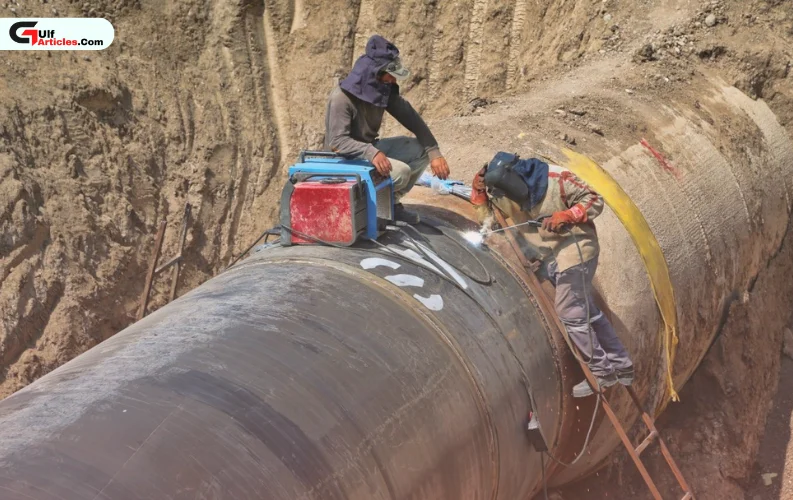
The UAE is moving rapidly to reinforce its long-term energy security strategy as ADNOC’s West-East oil pipeline project approaches a major construction milestone. According to Dr Sultan Ahmed Al Jaber, Minister of Industry and Advanced Technology and Managing Director and Group CEO of ADNOC, the strategic pipeline designed to bypass the Strait of Hormuz is now nearly 50 percent complete.
Speaking during a live-streamed event hosted by the Atlantic Council, Al Jaber confirmed that the project is being fast-tracked toward its targeted completion date in 2027.
“Today, it’s already almost 50% complete, and we are accelerating its delivery toward 2027,” he stated during the discussion.
The new pipeline forms a critical part of the UAE’s broader strategy to reduce dependence on the Strait of Hormuz, one of the world’s most strategically sensitive oil transit corridors. Global energy markets have long viewed the Strait as a vital shipping route, with any disruption carrying the potential to impact international oil supplies and pricing stability.
Highlighting the importance of diversified export infrastructure, Al Jaber noted that the UAE made the strategic decision more than a decade ago to invest in alternative export routes outside Hormuz.
“Too much of the world’s energy still moves through too few choke points,” Al Jaber said, emphasizing the need for resilient and secure export systems.
The UAE has significantly expanded its energy infrastructure in Fujairah, located on the Gulf of Oman coast, enabling crude oil exports to bypass the Strait entirely. Once operational, the new West-East pipeline is expected to substantially increase ADNOC’s export flexibility and strengthen the country’s ability to maintain uninterrupted supply during periods of regional instability.
The latest update follows recent directives issued by Sheikh Khaled bin Mohamed bin Zayed Al Nahyan, Crown Prince of Abu Dhabi and Chairman of the Abu Dhabi Executive Council, who instructed ADNOC to accelerate development of the project during a board executive committee meeting last week.
Industry analysts believe the pipeline could play a transformative role in the region’s energy logistics network. ADNOC’s existing Habshan-Fujairah pipeline currently transports up to 1.8 million barrels of crude oil per day and has become increasingly important amid ongoing geopolitical tensions across the Gulf region.
The upcoming expansion is expected to nearly double ADNOC’s export capacity through Fujairah once completed in 2027, significantly boosting the UAE’s strategic energy positioning in global markets.
During the same event, Al Jaber also addressed the impact of recent regional conflict on ADNOC’s facilities and infrastructure. He confirmed that the company is still assessing operational damage and financial costs after some sites were directly affected.
According to Al Jaber, restoring full operations at certain facilities could take several weeks or months depending on the extent of the damage, while returning to pre-conflict production and export levels may require at least four months.
Despite these challenges, the UAE continues to advance major infrastructure investments aimed at enhancing energy reliability, export resilience, and long-term market stability.












Comments 0
No comments yet. Be the first to share your thoughts.
Leave a comment
Your email is never published. All fields are required.