

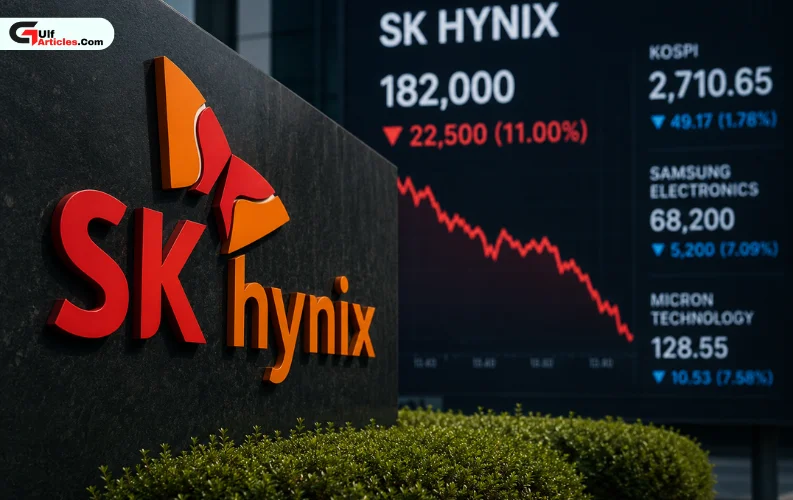
SK Hynix shares plunged more than 11% on Thursday, leading a broad sell-off in Asian semiconductor stocks after weakness in U.S. chipmakers triggered fresh concerns over elevated valuations in the artificial intelligence sector.
The sharp decline erased much of the company's previous session gains and marked another volatile trading day for the South Korean memory chip manufacturer. Domestic rival Samsung Electronics also fell more than 7%, while Seoul Semiconductor declined over 5%. LG Innotek and Samsung SDI also traded lower as investors reduced exposure to technology stocks.
The weakness quickly spread across regional markets. In Japan, semiconductor testing equipment maker Advantest dropped more than 6%, SoftBank Group slipped nearly 7%, Tokyo Electron lost over 5%, and Renesas Electronics declined around 4%.
Asian markets followed a weak overnight session on Wall Street, where major U.S. semiconductor companies closed sharply lower. Micron Technology fell approximately 8%, Intel lost more than 4%, while Lam Research and Advanced Micro Devices (AMD) each declined around 3%.
Market analysts attributed the latest decline primarily to profit-taking after months of strong gains driven by optimism surrounding artificial intelligence investments.
Investor sentiment was also affected after New York temporarily paused approvals for new large-scale data center projects while the state develops updated environmental and infrastructure standards. Reports indicating cloud infrastructure company CoreWeave is evaluating strategies to hedge against potential declines in memory chip prices further added to market caution.
Despite the sharp correction, industry experts believe the long-term outlook for semiconductor companies remains positive. Demand for high-bandwidth memory (HBM) chips continues to exceed supply as cloud service providers and technology companies accelerate investments in AI infrastructure. This ongoing demand has helped major memory manufacturers, including SK Hynix and Micron Technology, maintain strong pricing power.
The market pullback also came despite encouraging developments from Dutch semiconductor equipment maker ASML, which recently raised its full-year sales forecast for the second time this year and announced plans to further expand production of its advanced extreme ultraviolet (EUV) lithography systems.
Analysts say the latest market decline reflects a reassessment of valuations rather than weakening industry fundamentals. Semiconductor companies have been among the biggest beneficiaries of the global AI boom, but investors are becoming increasingly cautious after the sector's rapid rise over the past year.
While short-term volatility may continue, the semiconductor industry's long-term growth prospects remain supported by sustained investment in artificial intelligence, cloud computing, and next-generation digital infrastructure.
You may also like that news:-















Comments 0
No comments yet. Be the first to share your thoughts.
Leave a comment
Your email is never published. All fields are required.