

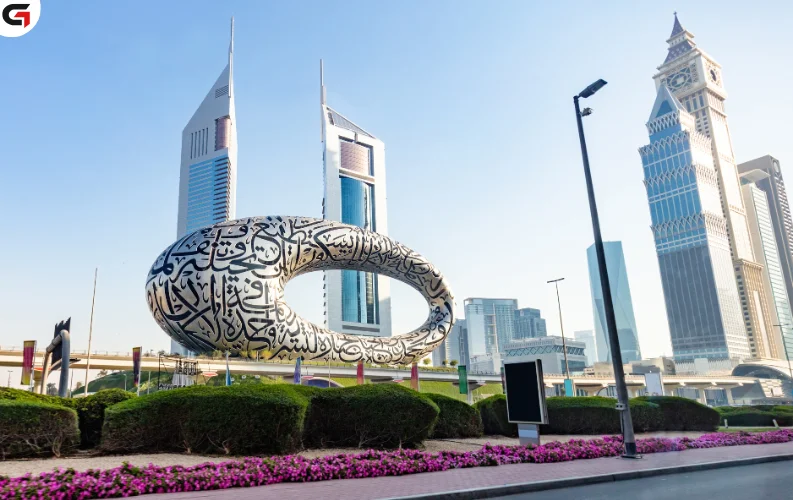
Dubai — UAE businesses are demonstrating some of the highest confidence levels globally in navigating shifting trade and tariff conditions, according to HSBC’s latest Global Trade Pulse Survey, which assesses corporate sentiment across 17 international markets.
The survey indicates that UAE companies are outperforming global peers in both revenue gains and visibility into future trade conditions, even as firms elsewhere continue to report weaker outlooks and uncertainty. Respondents highlighted strengthened regional partnerships and a more deliberate approach to securing supply chains and production bases.
Revenue resilience outpaces other markets
Sixty-eight per cent of UAE firms reported revenue growth linked to recent tariff and trade policy changes over the past six months, well above the global average of 56 per cent. Only 15 per cent of UAE businesses said they experienced any negative revenue impact, compared with 26 per cent globally.
The findings also show improved clarity around trade policies. Seventy per cent of UAE respondents said they now have a better understanding of how changing tariff frameworks affect their operations, slightly ahead of the global figure of 66 per cent.
UAE companies deepen links with South Asia
HSBC’s analysis shows UAE corporates are increasingly expanding production and sourcing in South Asia as they look to secure new channels and reduce exposure to global uncertainty. Nearly nine in ten UAE businesses (89 per cent) expect their international trade volumes to rise over the next two years.
India has emerged as a leading destination, with 31 per cent of UAE firms increasing production there, compared with an 18 per cent global average. Production shifts to Sri Lanka are also more common among UAE companies, with 11 per cent reporting increased activity, more than double the global rate of 5 per cent.
Deyana Cherneva, Head of Global Trade Solutions for the Middle East, North Africa and Türkiye at HSBC Bank Middle East, said UAE corporates are approaching the evolving trade landscape with intent.
“UAE businesses are not only adapting to the current trade environment but are seizing the opportunity to re-shape their businesses to capture growth,” she said. “The deepening ties with South Asian producers reflect the strengthening economic bridge between Asia and the Middle East.”
Global sentiment varies, but UAE stands out
The survey collected responses from more than 6,750 senior decision-makers worldwide and recorded wide variations in how companies perceive the impact of tariffs and shifting geopolitical conditions. However, the UAE ranked among the most confident, supported by strong regional integration, economic stability and an outlook that continues to prioritise expansion.
As global supply chains adjust to new economic realities, the study suggests UAE firms are positioned to navigate uncertainty more effectively than many of their international peers, aided by strategic positioning and long-term partnerships across key markets.






Comments 0
No comments yet. Be the first to share your thoughts.
Leave a comment
Your email is never published. All fields are required.