


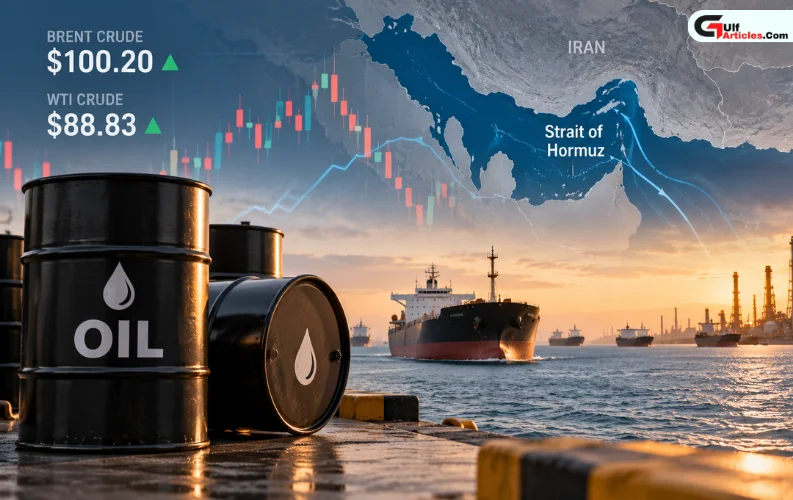
According to market data from Asian trading hours, US benchmark West Texas Intermediate (WTI) crude rose 3.05% to $93.30 per barrel, while Brent crude, the global benchmark, advanced 2.99% to reach $95.99 per barrel.
The latest gains place both benchmarks near their highest levels in months and within striking distance of the psychologically important $100-per-barrel mark, a level last witnessed during the energy market turmoil that followed the Russia-Ukraine conflict in 2022.
Market sentiment continues to be supported by concerns over tightening global crude supplies. Traders remain focused on developments surrounding key shipping routes and geopolitical tensions that could affect the smooth flow of oil exports. The Strait of Hormuz, one of the world's most critical energy transit corridors, remains under close watch as shipping activity has yet to fully normalize despite recent diplomatic efforts aimed at easing regional tensions.
Investors are also closely monitoring policy decisions from the OPEC+ alliance, whose production targets play a crucial role in determining global supply levels. Any indication of output adjustments from the group could significantly influence price direction in the coming weeks.
Adding further support to crude prices are expectations of stronger fuel consumption during the Northern Hemisphere's peak travel season. Increased transportation activity and seasonal demand are anticipated to place additional pressure on already constrained inventories.
However, analysts caution that challenges remain. Concerns over persistent inflation, higher interest rates, and slowing economic growth in several major economies could limit energy demand and create headwinds for the market.
Not all energy commodities followed oil's upward trajectory. US natural gas futures declined 1.83% to $3.17 per million British thermal units, while Murban crude, a key benchmark from the Middle East, remained below recent highs.
The energy market has experienced significant volatility over the past several years, driven by geopolitical conflicts, shifting production policies, and uncertainty surrounding the pace of global economic recovery. As a result, investors are expected to remain highly attentive to inventory reports, economic indicators, and OPEC+ policy signals for clues about the sustainability of oil's latest rally.
With supply concerns persisting and seasonal demand expected to strengthen, market participants will be watching closely to see whether crude prices can successfully break through the $100-per-barrel barrier in the months ahead.
You may also like that news:-














Comments 0
No comments yet. Be the first to share your thoughts.
Leave a comment
Your email is never published. All fields are required.