

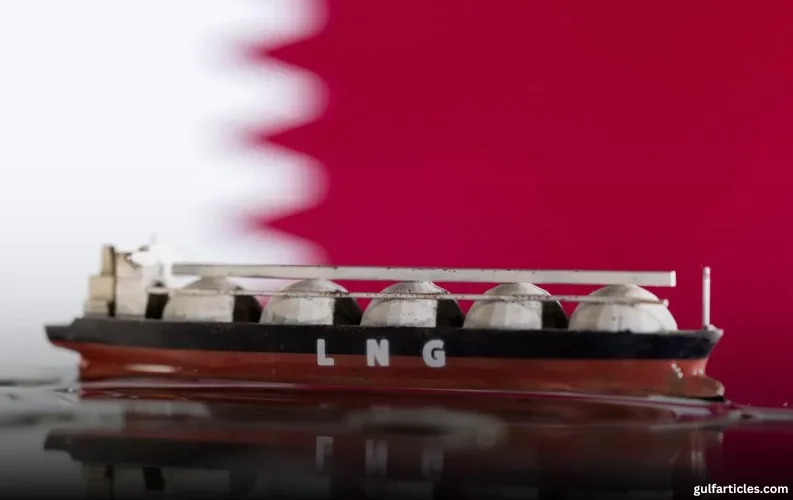
Doha – The Middle East is set to play an increasingly dominant role in global liquefied natural gas (LNG) trade, with exports projected to reach 202 million tonnes by 2050, according to the latest Global Gas Outlook 2050 released by the Gas Exporting Countries Forum (GECF).
The surge in exports will be powered largely by Qatar’s ambitious LNG expansion plans, which will significantly bolster the region’s global market share. GECF forecasts a substantial rise in net LNG exports from the Middle East, from 96 million tonnes in 2023 to 188 million tonnes by mid-century, underscoring the region’s long-term energy export strategy.
“Qatar will continue to lead the LNG supply landscape globally, driven by the phased expansion of its North Field, which will nearly double its capacity by 2030,” GECF stated.
Qatar at the Helm of LNG Growth
Qatar, already the world’s leading LNG exporter with 78 million tonnes exported in 2023, is projected to expand output capacity by approximately 85%, reaching 142 million tonnes per year by 2030. This growth stems from the North Field Expansion project, which includes East (NFE), South (NFS), and West (NFW) development phases.
This strategic expansion aligns with the country’s Qatar National Vision 2030, ensuring that energy exports continue to support the nation's sustainable economic development.
Asia remained Qatar’s core market in 2023, absorbing nearly 75% of its LNG shipments. By 2050, the Asia Pacific region is expected to receive over 178 million tonnes, accounting for approximately 90% of all Middle Eastern LNG exports.
Self-Sufficiency and Shifting Trade Routes
The GECF report also highlights the Middle East’s complete self-sufficiency in LNG, ensuring that all imports are domestically sourced. In 2023, the region’s net gas exports totaled 139 billion cubic metres (bcm). That figure is forecast to climb to 289bcm by 2050, further establishing the region’s strategic role in global gas markets.
While Asia’s demand will fuel export growth, Europe’s share is expected to decline significantly due to its pivot toward alternative and renewable energy sources. Similarly, Africa’s role as a destination market will see a temporary rise by 2030 but will eventually recede by 2050.
“These shifts point to an increasingly Asia-centric LNG trade dynamic for the Middle East, with long-term partnerships and market integration taking precedence over volume diversification,” the GECF added.
Domestic Demand and Infrastructure
Rising domestic demand across the Middle East, largely driven by population growth and heavily subsidised gas prices, has also shaped recent trends. Subsidies have supported economic growth and energy-intensive industries while making gas more accessible to the population.
Although most attention has centered on LNG shipments to Asia and Europe, intra-regional trade through export pipelines has continued, albeit on a smaller scale. Notable examples include Qatar’s pipelines to the UAE and Oman, as well as Iran’s gas exports to Iraq, Turkey, Armenia, and Azerbaijan.
Kuwait to Lead Regional Import Growth
While the Middle East remains a net exporter, LNG imports are projected to rise modestly to 14 million tonnes by 2050, with Kuwait contributing approximately 50% of this volume. The remainder will support energy needs in smaller Gulf nations adapting their own energy mixes.
Conclusion
The GECF’s latest forecast reinforces the strategic energy dominance of the Middle East, driven by Qatar’s bold expansion and Asia’s rising energy demand. As the global energy landscape evolves, the region appears well-positioned to adapt, invest, and lead in a future increasingly reliant on flexible and reliable LNG supplies.





Comments 0
No comments yet. Be the first to share your thoughts.
Leave a comment
Your email is never published. All fields are required.