

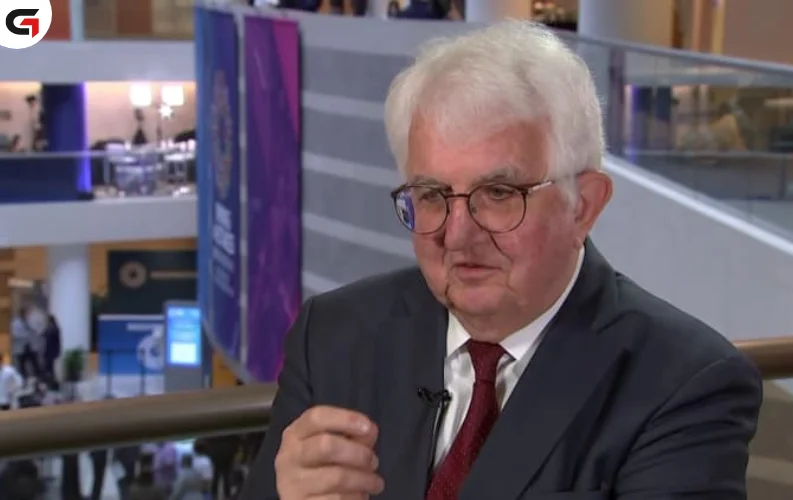
FRANKFURT, Germany — As the European Central Bank (ECB) edges closer to completing its inflation-control mandate, policymakers this week signaled growing unease over the global trade environment. A series of remarks from top ECB officials during the IMF and World Bank Spring Meetings revealed a cautiously optimistic stance on disinflation — tempered by the looming specter of tariff escalations and geopolitical uncertainty.
Key Highlights:
-
ECB President Christine Lagarde confirmed disinflation is “nearing completion.”
-
Policymakers flagged risks from U.S. tariffs and the uncertain global trade climate.
-
Several ECB members hinted at rate cuts in 2025 but stressed data dependency.
-
Concerns rise over medium-term inflation from potential retaliation and global supply chain disruption.
Inflation Fight Almost Won, But at What Cost?
ECB President Christine Lagarde reaffirmed the euro zone’s progress toward meeting its inflation target by 2025. Speaking to CNBC, she stated, “The disinflationary process is so much on track that we are nearing completion.” However, Lagarde acknowledged economic shocks remain a critical concern.
“Shocks will dampen GDP — they are a negative demand shock,” she noted, highlighting that fiscal stimulus from Germany and unpredictable trade developments could alter inflation dynamics.
She also pointed to volatility in currency markets, emphasizing that earlier ECB forecasts had expected a stronger dollar and weaker euro, but market reactions have been counterintuitive.
Tariff Turbulence and Market Anxiety
As the U.S. considers expanding tariffs on Chinese goods, European policymakers are grappling with how retaliation — and the uncertainty surrounding it — could distort the inflation outlook.
Klaas Knot, President of the Netherlands Bank, cautioned that the current trade environment resembles the high-uncertainty days of the COVID-19 pandemic.
“Uncertainty is like a tax without revenue,” Knot said. “In the short run, it’s crystal clear this uncertainty works as a strong negative factor for growth.”
He warned that while short-term inflation might drop due to falling energy prices and a stronger euro, the medium-term picture could be far murkier. Trade retaliation, disrupted supply chains, and fiscal policy shifts could ultimately reintroduce inflationary pressures.
Knot also urged caution regarding any assumptions about further ECB rate cuts in June, adding that decisions will rely heavily on the next set of projections.
A Wait-and-See Approach: Data-Driven but Politically Alert
Robert Holzmann, Governor of Austria’s National Bank, echoed similar sentiments, pointing to the unprecedented level of policy uncertainty.
“We have not seen this much uncertainty for years,” he told CNBC, noting that political decisions around tariffs — and their potential European countermeasures — would be central to any future monetary decisions.
While Holzmann acknowledged consensus around April's rate cut, he emphasized that the ultimate inflation path hinges on whether Europe imposes retaliatory tariffs.
“Without countermeasures, price pressure is likely downward. But with them, inflation might rise,” he explained.
Opportunities Amid Vulnerability
Mārtiņš Kazāks, Governor of the Bank of Latvia, offered a more strategic viewpoint. He argued that while the current situation is fraught with risks, it presents a turning point for Europe to consolidate its geopolitical influence.
“This is a time of opportunities,” Kazāks declared. “Europe must embrace the chance to evolve into a true economic and geopolitical superpower.”
He called on European leaders to demonstrate political courage and commit to decisions that will future-proof the continent’s economy and global standing.
Kazāks also noted that, so far, European financial markets have reacted with composure to global tariff threats, though macroeconomic scenarios remain wide open with no clear dominant forecast.
Conclusion: Data Dependency in a Geopolitical World
The ECB’s message this week is clear: while inflation is under control for now, the future trajectory hinges less on domestic monetary tools and more on unpredictable global developments.
The push-and-pull between economic fundamentals and geopolitics — especially U.S.-China tensions — has introduced a layer of complexity that demands vigilance.
What to Watch:
-
June’s ECB meeting: Will a second rate cut materialize?
-
U.S. trade policy developments and potential EU retaliation
-
Euro zone fiscal dynamics, especially in Germany and France
-
Currency market reactions to global trade shocks
As ECB officials emphasize a “data-dependent to the extreme” approach, Europe waits to see whether disinflation can stay the course — or whether the winds of global trade will blow policy off track once again.












Comments 0
No comments yet. Be the first to share your thoughts.
Leave a comment
Your email is never published. All fields are required.