

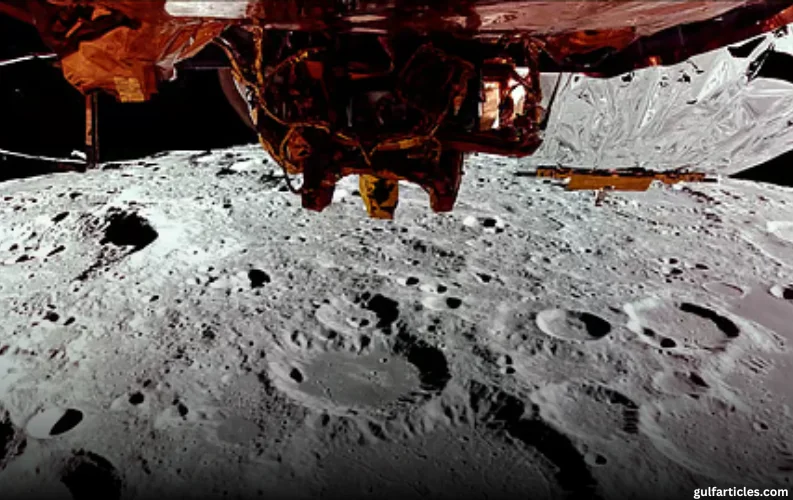
Washington, D.C.: The race to dominate the Moon is intensifying, with both government space agencies and private companies making significant strides in lunar exploration. The recent success of Firefly Aerospace’s Blue Ghost Mission 1, which landed upright on the Moon, marks a major milestone in commercial spaceflight and signals the growing role of private enterprises in deep-space missions.
Private Companies Drive Lunar Expansion
On March 2, 2025, Firefly Aerospace successfully landed its Blue Ghost spacecraft near Mons Latreille in the Mare Crisium region of the Moon. This achievement positions the Texas-based company at the forefront of private lunar exploration.
The mission comes at a time when multiple countries, including the United States, China, Russia, India, Japan, and the European Union, are accelerating their space programs with a strong focus on the Moon.
Firefly’s successful landing followed a similar attempt by Intuitive Machines, which became the first private company to land a spacecraft on the Moon in February. However, its Odysseus lander tipped over upon impact, limiting its ability to complete mission objectives.
New Era of Precision Moon Landings
Unlike previous missions, Blue Ghost demonstrated advanced autonomous navigation, allowing it to precisely target a safe landing site despite the Moon’s challenging terrain.
The spacecraft, launched aboard a SpaceX Falcon 9 rocket on January 15, 2025, traveled 2.8 million miles before reaching its destination. After a careful descent, the lander reduced its speed from thousands of miles per hour to just two miles per hour before touching down.
This mission is part of NASA’s Commercial Lunar Payload Services (CLPS) initiative, which aims to utilize private sector innovations to support lunar exploration and pave the way for future astronaut missions under the Artemis program.
Scientific and Technological Advances on the Moon
Blue Ghost is carrying ten scientific instruments, including:
- Lunar PlanetVac System – A tool designed to collect and sort lunar soil for research
- Radiation-Tolerant Computer – A system to test computing resilience in deep space
- Global Navigation Experiment – An initiative to explore whether Earth-based satellite systems can function on the Moon
The lander is expected to operate for 14 Earth days and will document key astronomical events, including the total solar eclipse on March 14, 2025. Another experiment scheduled for March 16 will examine how dust behaves under solar radiation, a phenomenon observed during the Apollo missions.
Growing Competition for Lunar Dominance
As private companies push deeper into space, global competition over the Moon is intensifying.
On March 7, 2025, Intuitive Machines launched its Athena lander (IM-2), which targeted Mons Mouton, the southernmost lunar landing site attempted to date. Although the lander landed on its side, key scientific instruments remained operational, providing valuable data on the Moon’s south pole—a region of interest due to potential water ice deposits.
Meanwhile, China’s Chang’e-6 probe is advancing its own lunar exploration objectives, while India, Russia, Japan, and the European Space Agency continue developing missions aimed at long-term lunar presence.
Why Private Companies Are Racing for the Moon
With interest in lunar exploration growing rapidly, private companies are driven by several key factors:
1. Economic Potential
-
Lunar mining: The Moon is believed to contain valuable resources, including helium-3, which could be used for future energy production.
- Space tourism: Companies are exploring the possibility of commercial lunar travel.
- Infrastructure development: Businesses are working on lunar habitats, communication systems, and transportation networks.
2. Strategic and Technological Leadership
-
First-mover advantage: Companies that establish infrastructure early may gain a competitive edge.
- Technological advancements: Innovations in robotics, AI, and propulsion systems are being driven by lunar missions.
- Influence in space governance: Those leading lunar exploration will have a role in shaping future space laws and policies.
3. Government Partnerships and Support
-
NASA contracts: Government agencies are investing in private space missions to reduce costs.
- Defense and security interests: Countries see strategic value in establishing a presence on the Moon.
4. The Moon as a Gateway to Mars
-
Testing ground for deep-space missions: The Moon provides a platform to prepare for Mars exploration.
- Lunar bases as staging points: Future missions could use the Moon as a launch site for interplanetary travel.
5. Corporate Prestige and Branding
-
Investor and public interest: Companies involved in space missions gain significant media attention and investment.
- National and corporate recognition: Being part of a successful lunar mission strengthens a company’s global reputation.
Future of Lunar Exploration
With private industry demonstrating increasing capabilities in space exploration, the future of lunar activity is shifting from government-led missions to a hybrid model involving both public and private sectors.
NASA’s $2.6 billion CLPS program is at the heart of this transformation, funding multiple private missions that aim to establish sustainable operations on the Moon.
However, uncertainties remain, particularly regarding NASA’s long-term focus. There is ongoing speculation that funding for the Artemis program—which aims to return humans to the Moon—could be redirected toward Mars exploration, an initiative strongly supported by former President Donald Trump and SpaceX CEO Elon Musk.
Regardless of shifting policies, one thing is clear: the race to establish a presence on the Moon is more competitive than ever. As nations and corporations continue their missions, the question remains: Who will rule the Moon?
















Comments 0
No comments yet. Be the first to share your thoughts.
Leave a comment
Your email is never published. All fields are required.