

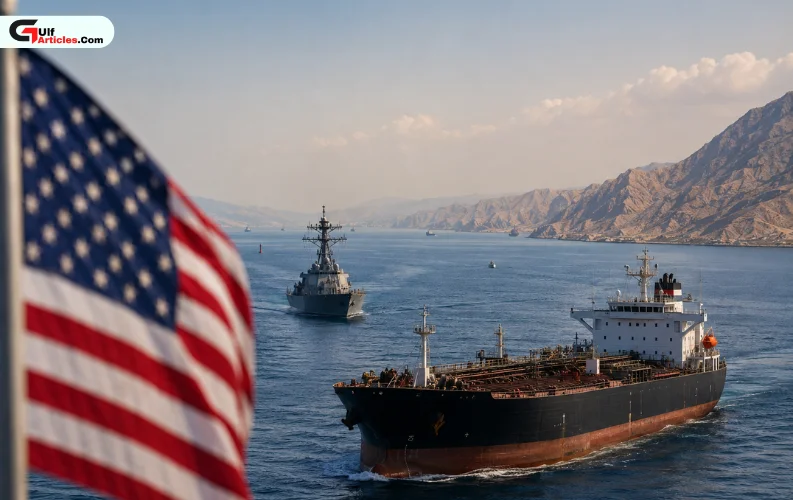
The United States has redirected 55 commercial vessels away from Iranian ports under its naval blockade, as negotiations over reopening the Strait of Hormuz remain stalled and tensions continue to disrupt one of the world’s most important energy shipping routes.
U.S. Central Command said American forces redirected another 20 commercial ships last week, taking the total to 55 as of Sunday, up from 35 on Aug. 2.
According to the statement cited in the original report, U.S. forces have also disabled two vessels and boarded two others as part of efforts to enforce compliance with the blockade.
The latest figures signal that Washington is maintaining pressure on Tehran despite limited diplomatic movement toward restoring normal shipping through the strait.
The Strait of Hormuz has faced severe disruption for more than five months. Before the conflict began in February, the waterway handled roughly a quarter of global seaborne oil trade and about one-fifth of worldwide liquefied natural gas shipments.
Iran says negotiations cannot resume under current conditions
Iranian Foreign Minister Abbas Araghchi said on Sunday that there was no immediate prospect of restarting negotiations with the United States while Washington continued what Tehran considers violations of an earlier memorandum of understanding.
Araghchi said intermediaries were still working to identify a path back to negotiations, but he maintained that outstanding disputes would have to be addressed first.
His comments came as both sides appeared to harden their positions over the conditions required for reopening the Strait of Hormuz.
Iran has reportedly demanded that the United States lift its naval blockade and sanctions, withdraw American forces from the region, release frozen Iranian assets and provide compensation linked to the conflict.
Washington has not indicated that it is prepared to accept those demands.
Trump signals preference for continued economic pressure
U.S. President Donald Trump has suggested that Washington may be prepared to allow economic pressure on Iran to intensify rather than immediately launch a new military offensive.
Trump said the United States was taking a lower-key approach to negotiations and watching Iran’s worsening economic situation.
The president has also highlighted the decline in the Iranian rial, arguing that economic pressure is weakening Tehran’s position.
The shift in tone suggests that the administration may currently see financial and maritime pressure as more effective than an immediate escalation in military action.
Oman pushes diplomatic efforts
Iran has also been holding separate discussions with Oman aimed at establishing defined transit arrangements through the Strait of Hormuz.
Araghchi said those discussions had made significant progress and were approaching their final stage, although he stressed that such an agreement would not amount to a full reopening of the waterway.
Oman described the talks as taking place in a positive and constructive atmosphere and called for an end to repeated attacks on commercial vessels to create more room for diplomacy.
The Gulf state has frequently acted as an intermediary between Iran and Western governments during periods of heightened regional tension.
Shipping remains under pressure
Security risks across both the Strait of Hormuz and the Red Sea continue to weigh heavily on international shipping.
The United Arab Emirates said Iran launched a missile at an oil tanker operated by the Abu Dhabi National Oil Company while the vessel was attempting to pass through the strait on Saturday.
Separately, Yemen’s Iran-backed Houthi movement claimed responsibility for attacks targeting an oil facility in Saudi Arabia and infrastructure near the Red Sea port city of al-Makha.
The continued attacks have made shipping companies increasingly cautious about using both routes, placing further pressure on global energy and freight flows.
Shipping data cited in the report showed only eight confirmed crossings through the Strait of Hormuz last Friday, a decline of 33% from the previous day.
Oil prices rise as uncertainty persists
Energy markets responded to the continuing tensions on Monday.
International benchmark Brent crude rose nearly 1% to $84.22 a barrel, while U.S. West Texas Intermediate futures gained around 0.6% to $78.63.
Analysts remain cautious about the outlook.
Warren Patterson, head of commodities strategy at ING Bank, said the gap between the positions of Washington and Tehran made a lasting agreement more difficult to achieve.
ING maintained its forecast for Brent crude to average about $80 a barrel during the quarter, while warning that substantial uncertainty remained around that outlook.
The bank expects energy flows to gradually normalise during the third quarter, although renewed deterioration in the regional security situation could quickly alter that expectation.
Iran considers restrictions on Hormuz traffic
Iranian state media has also reported that lawmakers are reviewing a draft framework that could impose new restrictions on vessels passing through the Strait of Hormuz.
Under the reported proposal, U.S. and Israeli ships could be barred from the strait, while countries considered hostile by Tehran could be required to provide compensation before receiving transit approval.
The draft also reportedly proposes financial penalties for vessels that violate the restrictions, potentially amounting to 20% of the value of cargo carried by the ship.
The proposal has not yet been adopted.
For global energy markets, the combination of restricted shipping, rising military tension and stalled diplomatic negotiations continues to create significant uncertainty.
With the United States maintaining its naval blockade and Iran refusing to resume negotiations under current conditions, a rapid return to normal shipping through the Strait of Hormuz appears increasingly difficult.
You may also like that news:-












Comments 0
No comments yet. Be the first to share your thoughts.
Leave a comment
Your email is never published. All fields are required.