
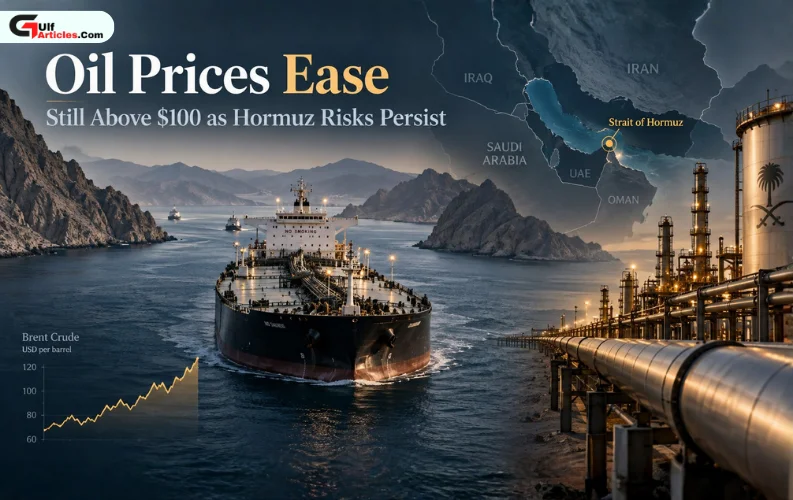
Oil prices edged lower in early Monday trading after a sharp weekly rally, but crude remained firmly above $100 a barrel as attacks on shipping and disruption to a major Saudi pipeline kept global supply concerns elevated.
Brent crude fell around 2.8% to $104.60 a barrel, while U.S. West Texas Intermediate (WTI) was around $100, according to market data cited by Gulf News. Despite the early decline, both benchmarks had gained more than 8% over the previous week after briefly climbing above $107.
Profit-Taking Brings Some Relief
The early decline appears to reflect some profit-taking after oil's steep advance rather than a major improvement in the supply outlook.
Traders are also weighing diplomatic efforts aimed at restoring commercial shipping through the Strait of Hormuz, although uncertainty remains over whether those efforts will succeed. The market continues to carry a significant geopolitical risk premium because a fresh attack could quickly push prices higher again.
Hormuz Remains the Biggest Concern
The Strait of Hormuz remains at the centre of the oil-market crisis because of its importance to global energy shipments.
Recent reports of attacks on vessels have increased concerns about the safety of commercial shipping through the waterway. Iranian state media also reported that an Iranian commercial vessel was hit near Qeshm Island, while the UK Maritime Trade Operations agency received a report of a projectile striking another vessel in the strait.
Any prolonged disruption could have consequences for refiners, shipping companies and major oil-importing economies around the world.
Saudi Pipeline Shutdown Adds Fresh Pressure
The situation has become more complicated following the temporary shutdown of Saudi Arabia's East-West oil pipeline.
The pipeline provides an alternative route for Saudi crude exports by allowing oil to move toward the Red Sea without passing through Hormuz. Its closure therefore removes an important backup route at precisely the time when the main shipping corridor is already facing security concerns.
Reuters reported that the shutdown could put as much as 4% of global oil supply at risk, while industry sources estimated that inventories at Yanbu could cover only around five to seven days of exports if the disruption continued.
Houthi Attacks Increase Regional Risk
The pipeline incident followed attacks by Houthi forces on Saudi Arabia, adding another potential threat to the region's energy infrastructure.
The Houthis have also expanded their presence around the Bab el-Mandeb Strait, another strategic shipping route linking the Red Sea with the Gulf of Aden. The growing risks around both waterways mean traders are now monitoring several potential bottlenecks rather than focusing only on Hormuz.
This increases the possibility of further disruptions if attacks spread to additional oil facilities, tankers or shipping lanes.
Diplomatic Efforts Offer Limited Hope
There are still attempts to ease the situation diplomatically.
Officials in Oman had been preparing for discussions involving Gulf countries and Iran over shipping arrangements in the Strait of Hormuz. Reports suggested the discussions could include temporary lanes for commercial vessels. However, the meeting was postponed, underscoring how difficult it has become to reach an immediate solution.
Markets are therefore unlikely to treat diplomatic signals as a lasting solution until shipping activity returns to more normal levels.
Oil Prices Could Rise Again
The direction of crude prices in the coming days will depend heavily on whether attacks continue and whether alternative export routes remain operational.
A credible agreement that restores safe passage through Hormuz could remove some of the risk premium currently built into oil prices. But another attack on a vessel or additional damage to Middle Eastern energy infrastructure could quickly push prices back toward recent highs.
For consumers, the risks extend beyond the price of crude itself. Sustained oil above $100 could increase gasoline, diesel, transportation and production costs, adding to inflationary pressure in major economies.
Markets Remain on Edge
Monday's decline offers only limited reassurance. Oil is still trading well above $100, following a week of exceptionally strong gains, while the security situation around Hormuz and other regional energy routes remains unresolved.
The market is now balancing two competing forces: profit-taking and hopes for diplomatic progress on one side, and the threat of further supply disruptions on the other.
Until shipping through the region becomes more reliable and Saudi Arabia's alternative pipeline network is restored, global oil markets are likely to remain highly sensitive to every new development in the Middle East.
You may also like that news:-