

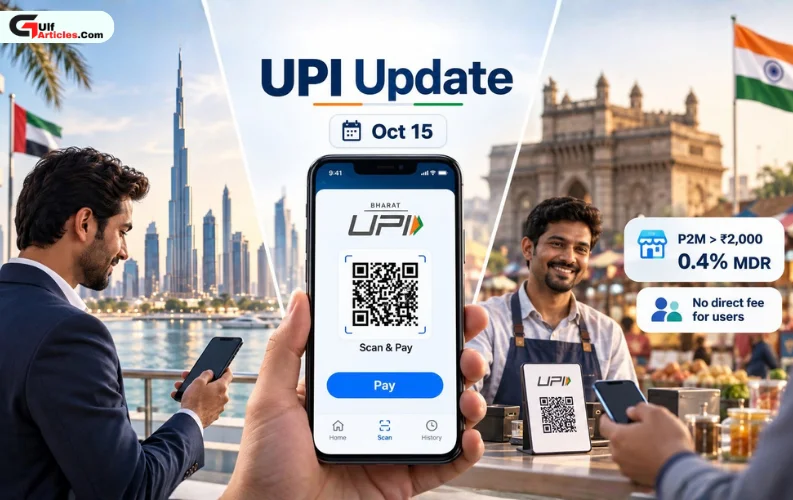
UAE-based Indians who use India's Unified Payments Interface (UPI) for payments in India will continue to use the system without paying a direct transaction fee, even after a new Merchant Discount Rate (MDR) framework takes effect on October 15, 2026.
The new rules introduce a 0.4% MDR on selected person-to-merchant (P2M) UPI transactions above ₹2,000, but the charge is imposed within the payment ecosystem on eligible merchants and service providers, rather than on the customer making the payment. The government has also said merchants cannot separately pass the MDR on to buyers.
UAE NRIs Will Not Pay a New UPI Fee
For UAE-based Indians, the most important point is that the October 15 change does not create a customer charge simply because someone is an NRI or uses UPI from a UAE-linked account.
NRIs with eligible NRE or NRO accounts can use UPI through supported applications and international mobile numbers, subject to their bank's rules. The new MDR framework applies according to the type and value of the transaction, not the customer's residency status.
This means a UAE NRI paying a restaurant, retailer or other eligible merchant in India will not see an additional UPI fee added to the bill simply because the payment exceeds ₹2,000.
What Changes From October 15?
Under the new framework, eligible P2M transactions above ₹2,000 will attract an MDR of 0.4%.
The charge is capped at ₹300 for transactions of ₹75,000 or more. A ₹10,000 purchase, for example, carries an MDR of ₹40 within the payment ecosystem, but the customer still pays the merchant ₹10,000, not ₹10,040.
Payments of ₹2,000 or less remain free of MDR, while certain small merchants also continue to receive zero-MDR treatment.
Money Sent to Family Will Remain Free
Many UAE NRIs use UPI to send money to parents, children and other family members in India.
Those person-to-person (P2P) transfers will remain completely free, regardless of the amount transferred. The ₹2,000 threshold does not apply to ordinary transfers between individuals.
For example, sending ₹50,000 to a parent in India through a personal UPI transfer will not attract the new MDR.
The same applies to transferring money between one's own eligible linked bank accounts.
Small Shops Get Special Protection
The new framework also protects many smaller businesses.
Small merchants operating under the P2PM category and receiving up to ₹1 lakh per month through UPI QR payments can continue to receive payments without MDR. This is intended to protect neighbourhood shops, street vendors and other small businesses from additional processing costs.
As a result, a UAE NRI shopping at a qualifying small shop may continue to make UPI payments without any change, even when an individual purchase exceeds ₹2,000.
Some Essential Payments Have a Flat ₹5 MDR
The rules also provide a different structure for selected essential and low-margin sectors.
For fuel, railway services, telecommunications, insurance and agricultural inputs, transactions above ₹2,000 will generally carry a flat ₹5 MDR instead of the standard 0.4% rate.
For customers, however, the government's stated policy remains the same: the MDR is not supposed to become a separate payment charge at checkout.
Investments Have a Separate Rate
UAE NRIs using UPI for Indian investment-related transactions should also be aware of a separate rate.
Payments involving mutual funds, securities, stockbrokers and dealers will attract an MDR of 0.02%, capped at ₹300. Again, this is an ecosystem-level charge rather than a fee imposed directly on the individual making the payment.
Regular automated payments made through UPI mandates or AutoPay are treated separately under the framework, according to the current guidance.
What About Using UPI in the UAE?
The October 15 MDR framework should not be confused with using UPI Global at participating merchants outside India.
NPCI says UPI can be used at selected international merchant locations through participating networks. Before confirming an overseas payment, users should check the foreign-currency amount, rupee equivalent, exchange rate and any applicable fee shown by the app.
Therefore, a UAE NRI making a UPI payment at a participating UAE merchant could encounter currency-conversion or cross-border costs that are separate from India's new domestic MDR framework.
Why Is India Introducing MDR?
The government says the new framework is aimed at creating a more sustainable financial model for UPI while continuing to protect consumers and small merchants.
According to the Finance Ministry, MDR will apply to only around 4% of merchant transactions, meaning about 96% of P2M transactions will remain unaffected. The government also says 5% of MDR collections will be directed toward a fund supporting wider UPI adoption among smaller merchants.
The changes come after years of rapid UPI growth and increasing discussion about how banks, payment providers and technology companies should finance the infrastructure behind the system.
What UAE NRIs Should Remember
For most UAE-based Indians, the practical impact is limited.
Sending money to family remains free. Paying merchants up to ₹2,000 remains free. Even for larger merchant payments, the new MDR is intended to be borne within the merchant payment ecosystem rather than added as a separate fee to the customer.
The main thing NRIs should watch for is any merchant attempting to add a separate “UPI fee” or MDR charge to the bill. The government has explicitly said customers should not be charged the MDR directly.
For UAE NRIs, therefore, October 15 is more a change in how UPI payments are funded behind the scenes than a new fee on everyday personal transfers or ordinary customer payments.
You may also like that news:-














Comments 0
No comments yet. Be the first to share your thoughts.
Leave a comment
Your email is never published. All fields are required.