

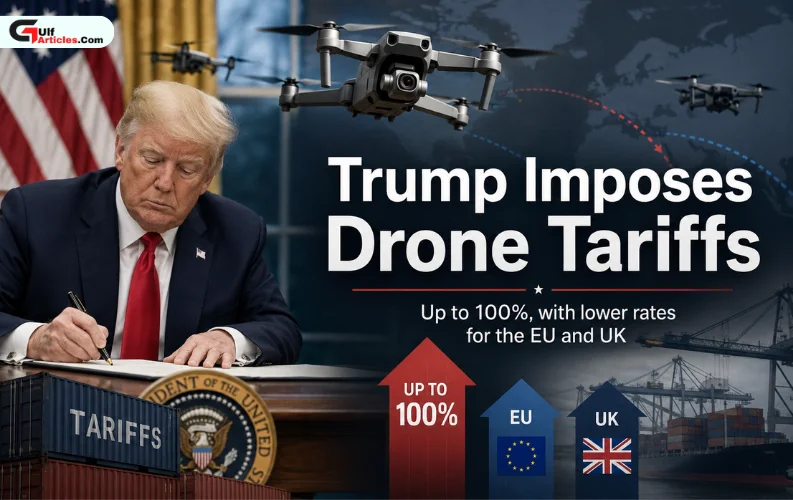
US President Donald Trump has ordered sweeping new tariffs on imported drones and key components, with duties reaching as high as 100% for certain advanced systems as his administration seeks to reduce America's dependence on foreign supply chains.
The new trade measures cover unmanned aircraft systems used across defence, security and commercial sectors. According to the White House, larger drones and models equipped with capabilities considered particularly sensitive to national security will face the steepest tariffs.
Under the plan, drones with a maximum takeoff weight above 25 kilograms, as well as systems with thermal imaging capabilities, will be subject to a 100% ad valorem tariff. The same rate will also apply to docking stations and some critical components linked to those systems.
Smaller drones that do not fall into the most sensitive category, along with certain other components, will face a 25% tariff.
EU and UK Receive Lower Tariff Rates
The administration has provided lower rates for several major US allies.
Drone products and components originating from the European Union, Japan, South Korea, Switzerland, Liechtenstein and Taiwan can qualify for a 15% tariff. Imports from the United Kingdom are eligible for a lower rate of 10%.
However, the reduced rates come with strict conditions.
The White House said substantially all of the hardware, software and technology used in qualifying products must originate either in the exporting country or in the United States.
That requirement could become an important issue for drone makers whose products are assembled domestically or in allied countries but rely on components sourced from elsewhere.
Manufacturers unable to meet the origin requirements could instead face the broader 25% or 100% tariff categories, depending on the type and capability of the drone.
Washington Cites National Security Concerns
The Trump administration has framed the decision primarily as a national security and industrial policy measure.
The White House said the United States remains heavily dependent on overseas sources for drones and critical unmanned aircraft components, creating potential vulnerabilities for defence, cybersecurity and other strategic operations.
A Commerce Department review concluded that foreign penetration of the US drone market was substantial and that domestic manufacturers were not producing enough equipment to meet the country's security requirements, according to the administration. Reuters also reported that the review raised concerns over security and safety risks linked to reliance on foreign suppliers.
Drones have become increasingly important in modern military operations, while their civilian applications have expanded across logistics, agriculture, infrastructure inspection, emergency response and surveillance.
The administration argues that expanding US manufacturing capacity is necessary to ensure access to critical systems during conflicts or supply disruptions.
Tariffs Will Be Introduced in Stages
The higher tariffs will not take effect immediately.
The main measures are scheduled to begin 21 days after the proclamation was signed on August 13, 2026. Less-sensitive drone components will receive a longer transition period, with tariffs on those products taking effect after 180 days.
Certain products that receive approved exemptions linked to federal security restrictions will also have a 180-day implementation period.
The proclamation additionally gives the Commerce Secretary authority to establish an onshoring programme designed to encourage companies to make new investments in US drone and component manufacturing.
Pressure Builds to Shift Drone Production to the US
For overseas manufacturers, the new policy is likely to place greater importance on where individual components are designed, produced and assembled.
Companies that already operate manufacturing facilities in the United States may have greater flexibility to adapt, while businesses dependent on international component networks could face higher costs or pressure to reorganise their supply chains.
The policy could also encourage foreign manufacturers seeking access to US customers to expand production inside the country.
For Washington, the tariffs form part of a wider effort to strengthen domestic manufacturing in industries considered important to national and economic security.
The immediate impact will depend on how manufacturers respond to the origin requirements and whether companies shift more production to the United States. What is clear is that the administration is treating drones not simply as another imported technology product, but as a strategic industry increasingly tied to America's defence and industrial capacity.
You may also like that news:-













Comments 0
No comments yet. Be the first to share your thoughts.
Leave a comment
Your email is never published. All fields are required.