

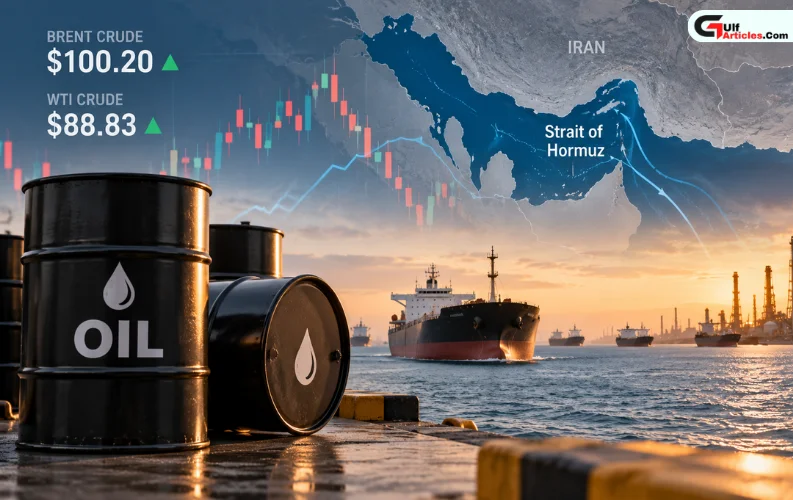
Oil prices remained volatile on Thursday as traders balanced improving Gulf oil exports against renewed security concerns around the Strait of Hormuz. Brent crude was around $100.20 a barrel, while U.S. West Texas Intermediate (WTI) stood at $88.83.
Hormuz Risks Keep Pressure on Oil Markets
The Strait of Hormuz remains a major source of uncertainty for energy markets. Recent attacks and security incidents involving tankers have raised concerns about the safety and cost of transporting oil through the key shipping route.
Although significant volumes of crude are moving again, traders remain cautious because any major disruption could quickly tighten global supplies and push prices higher.
Gulf Oil Exports Show Signs of Recovery
Gulf producers have managed to restore much of their oil exports by using alternative routes, pipelines and ship-to-ship transfers. Gulf crude and condensate exports excluding Iran reached around 16.5 million barrels per day in September, roughly matching pre-war levels.
However, a smaller share of those shipments is travelling directly through the Strait of Hormuz, reflecting continued concerns about security in the area.
Shipping Costs Add to Market Pressure
The recovery in exports has not fully translated into lower oil prices. High freight charges, war-risk insurance and longer or more complicated shipping routes continue to increase the cost of moving crude.
These logistical challenges are helping keep Brent close to the $100 mark even as physical oil flows improve.
Markets Remain Focused on Regional Developments
For now, oil traders are closely watching shipping activity around Hormuz and developments across the Gulf. A further improvement in exports could ease prices, while renewed attacks or a wider disruption could push crude higher.
The conflicting signals mean volatility is likely to remain a feature of the oil market as traders assess both recovering supply and continuing geopolitical risks.
You may also like that news:-













Comments 0
No comments yet. Be the first to share your thoughts.
Leave a comment
Your email is never published. All fields are required.