
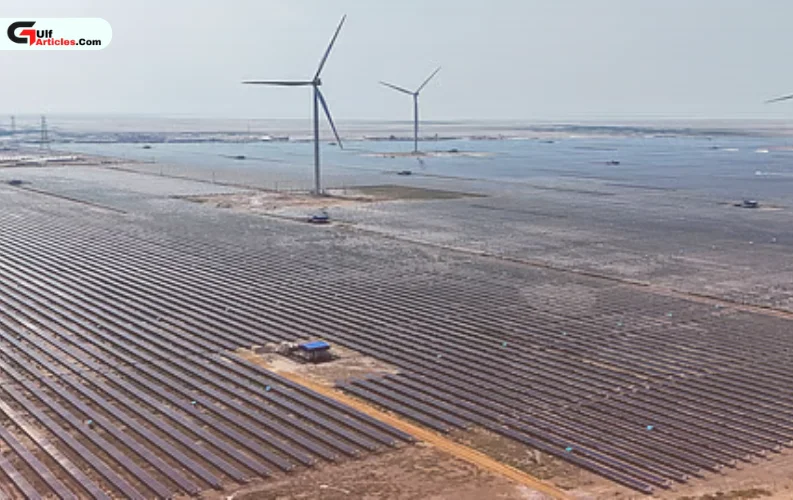
India is rapidly transforming the vast salt deserts of Gujarat’s Rann of Kutch into what is set to become the world’s largest renewable energy hub, marking a defining moment in the country’s clean energy transition.
Spanning an expansive 72,600 hectares, the Khavda Renewable Energy Park — also known as the Gujarat Hybrid Renewable Energy Park — is being developed with a planned capacity of 30 gigawatts (GW). Once fully operational, the project is expected to generate enough electricity to power approximately 18 million homes, positioning it as the largest single-site renewable energy project globally.
Located in one of the most barren and extreme landscapes in India, the project combines 20 GW of solar energy and 10 GW of wind power, creating a hybrid system designed to ensure more consistent power generation. While solar energy drives daytime production, wind energy contributes to round-the-clock output, addressing intermittency challenges often associated with renewable sources.
The initiative was launched in 2020, with Prime Minister Narendra Modi laying its foundation. Led primarily by Adani Green Energy, in collaboration with international partners such as TotalEnergies, the project has already crossed 1 GW of installed capacity as of early 2024. Full completion is expected in the coming years.
Beyond its scale, Khavda Park plays a crucial role in supporting India’s ambitious target of achieving 500 GW of renewable energy capacity by 2030. The project is also expected to contribute significantly to reducing dependence on fossil fuels, while enhancing long-term energy security.
However, the project is not without challenges. The harsh desert climate, including extreme heat and demanding working conditions, presents operational hurdles. Additionally, environmental concerns have been raised regarding the impact on fragile desert ecosystems, while experts continue to debate the need for large-scale energy storage solutions to manage supply fluctuations.
Despite these concerns, the project stands as a powerful symbol of engineering and environmental ambition. What was once considered an uninhabitable salt flat is now emerging as a critical pillar of India’s renewable energy future.
As construction progresses, Khavda is increasingly being viewed not just as infrastructure, but as a global benchmark — demonstrating how large-scale renewable projects can redefine landscapes, economies, and energy systems.