

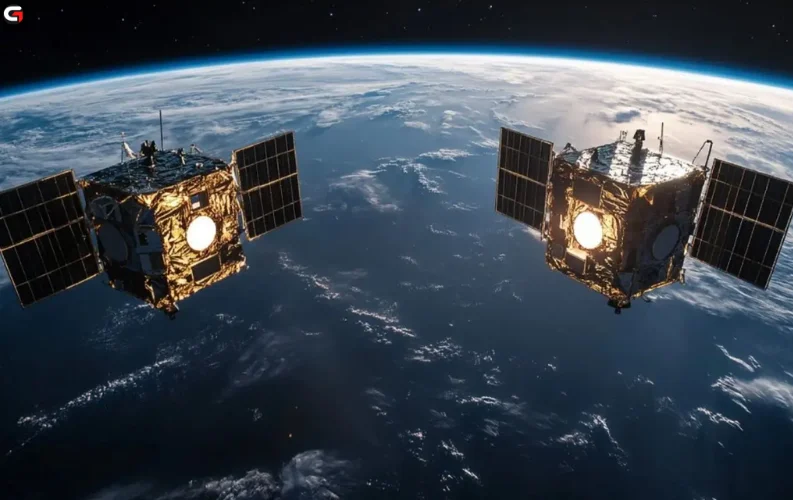
Bengaluru, India – In a groundbreaking trial, two Indian satellites maneuvered to within three meters of each other in space as part of the Indian Space Research Organisation's (ISRO) ambitious Space Docking Experiment (SpaDeX). The satellites, named SDX01 (Chaser) and SDX02 (Target), are now moving back to a safe distance after this historic approach, ISRO announced earlier today.
This maneuver is a preparatory step towards achieving autonomous docking—a highly intricate and precise procedure. The satellites, equipped with the indigenously developed Bhartiya Docking System, will eventually attempt a full docking after further analysis of the data collected during this trial.
"A trial attempt to reach up to 15 m and further to 3 m is done. Moving back spacecraft to a safe distance. The docking process will be done after analyzing data further," ISRO shared in its latest update.
A Dance of Precision in Space
Docking, often likened to a "handshake" in space, requires satellites to approach one another at extremely low speeds—in this case, just 10 millimeters per second. ISRO’s methodical approach ensures every step of the process is carefully calibrated, with rigorous ground tests preceding any commands sent to the spacecraft.
Launched on December 30 aboard the PSLV C60 rocket, the SpaDeX mission places India on the brink of becoming the fourth nation to achieve autonomous docking. The satellites were deployed into a 475-kilometer circular orbit and have since been undergoing a series of complex maneuvers to test their docking capabilities.
A Leap Toward Future Space Missions
This mission is a vital stepping stone for India’s ambitious projects, including the development of the Bharatiya Antariksh Station and upcoming lunar missions such as Chandrayaan 4. Autonomous docking is essential for assembling space stations, refueling spacecraft, and enabling longer-term missions.
ISRO Chief Dr. S. Somnath emphasized the challenges of this first-of-its-kind attempt for India:
"The docking exercise will be done only when all sensors have been fully calibrated and tested to satisfaction. All algorithms and scenarios are also tested on the ground before commands are sent to the spacecraft to do the docking autonomously."
What’s Next?
Once docked, the two satellites will function as a single spacecraft, sharing electrical power and data to test the success of the docking mechanism. The ultimate measure of success will be the satellites' ability to undock and operate independently, showcasing the robustness of ISRO’s technology.
This historic mission, described by some as a "ballet in space," exemplifies India’s growing prowess in space technology and sets the stage for future interplanetary and orbital missions.














Comments 0
No comments yet. Be the first to share your thoughts.
Leave a comment
Your email is never published. All fields are required.