

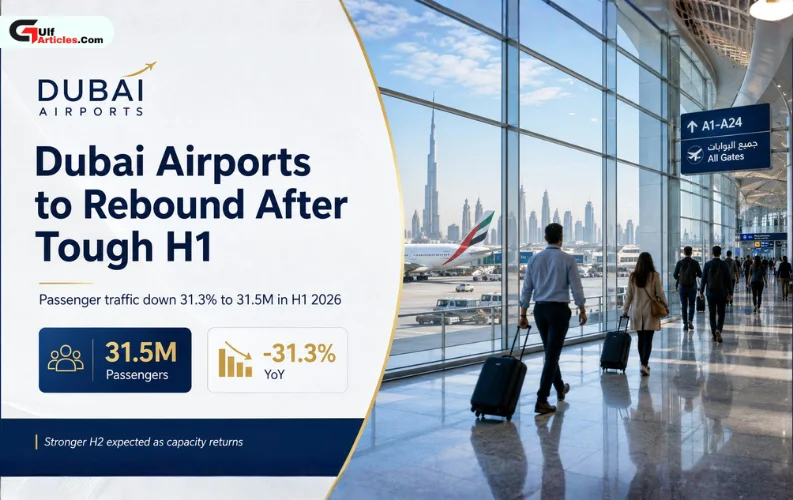
Dubai International Airport recorded 31.5 million passengers in the first half of 2026, down 31.3% from a year earlier, as regional airspace disruption weighed heavily on flight schedules before traffic began recovering during the second quarter.
DXB handled 13 million passengers between April and June, with monthly volumes improving from 3.5 million in April to 4.5 million in May and 5 million in June as airlines gradually restored capacity and international connectivity strengthened.
Aircraft movements fell 32.1% year on year to about 150,600 during the first six months, including approximately 62,500 movements in the second quarter.
Cargo traffic also declined, with DXB handling 751,340 tonnes in the first half, down 28.7% from the same period last year. Second-quarter cargo volumes stood at 351,716 tonnes.
The declines followed a period of severe disruption to aviation across the Middle East earlier in the year, when airspace restrictions and flight suspensions reduced airline capacity throughout the region.
Despite the weaker first-half comparison, Dubai Airports said the steady return of international airlines and improving passenger loads were supporting a stronger outlook for the remainder of the year.
Dubai Airports CEO Paul Griffiths said returning capacity was being met by immediate passenger demand, particularly important for DXB because connecting travellers represent a significant part of the airport's business.
By the end of June, nearly 50 international airlines were serving DXB, connecting Dubai with 217 destinations across 99 countries. Load factors were also moving closer to 2025 levels as airlines rebuilt their networks.
Service levels remain strong
DXB maintained high passenger-processing standards despite the disruption.
Dubai Airports said 98.98% of departing passengers cleared passport control within 10 minutes, while 98.95% of arriving passengers completed immigration procedures within 15 minutes.
Around 99.34% of passengers passed through security in less than five minutes.
The airport processed 30.3 million bags during the first half, down 28% year on year. Its mishandled baggage rate stood at 2.7 bags per 1,000 passengers, below the latest global industry benchmark of about 4.9 per 1,000.
Dubai Airports continues investment programme
Dubai Airports is continuing infrastructure and technology investments as passenger traffic rebuilds.
Projects include upgrades to passenger facilities, expanded self-service systems, further deployment of biometric technology, improvements to remote departure services and new operational tools designed to increase efficiency.
The investments are intended to improve passenger flows and provide additional operational flexibility as DXB prepares for higher traffic.
Stronger second half expected
Dubai Airports expects passenger volumes to strengthen during the second half of 2026 as airlines restore frequencies and international transfer traffic continues to recover.
The winter travel schedule, easing travel advisories in important markets and Dubai's calendar of international business, leisure and sporting events are also expected to support demand.
The improving second-quarter trend offers an early indication of the recovery. Monthly passenger volumes increased by about 43% between April and June as more capacity returned to the market.
DXB's performance in the coming months will be closely watched as Dubai works to restore aviation traffic following one of the most disruptive periods faced by the regional airline industry in recent years.
You may also like that news:-












Comments 0
No comments yet. Be the first to share your thoughts.
Leave a comment
Your email is never published. All fields are required.