

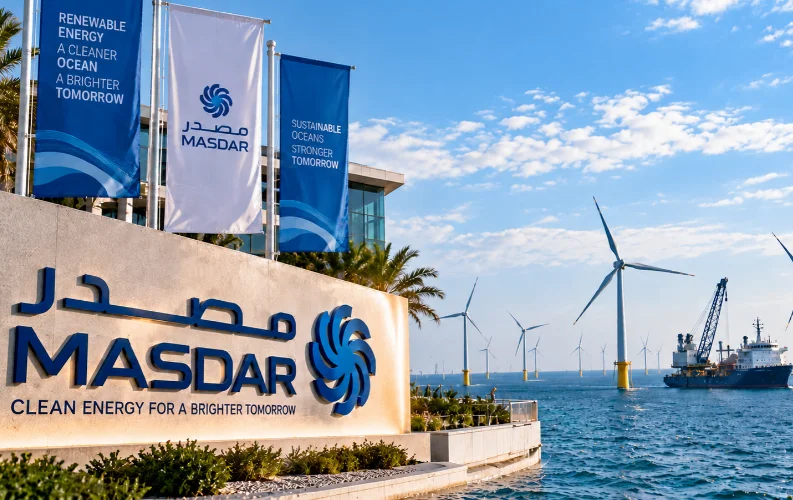
Abu Dhabi-based renewable energy company Masdar has raised $600 million through its first blue bond, marking a significant expansion of its sustainable financing programme. The five-year bond, announced on October 27, 2026, carries AA- ratings from S&P Global Ratings and Fitch Ratings, making it the highest-rated publicly issued corporate blue bond globally to date, according to the company.
The issuance is part of Masdar’s $6 billion Global Medium Term Note Programme and is designed to direct investment towards marine-based renewable energy projects, including offshore wind. The transaction attracted strong interest from international and regional investors, reflecting demand for sustainable finance opportunities despite challenging market conditions.
Strong Investor Demand Supports the Bond Issuance
The orderbook for Masdar’s $600 million bond peaked at $1.5 billion, making the offering approximately 2.5 times oversubscribed. The level of demand allowed the company to complete the transaction despite uncertainty in global financial markets.
The bond was issued on the London Stock Exchange’s International Securities Market with a US dollar coupon of 5.875%. It was subsequently swapped into euros at a yield of 4.374%, aligning the financing with Masdar’s investment exposure in European markets.
The transaction represents the company’s fourth bond offering under its financing programme. Since launching the programme in 2023, Masdar has raised a total of $3.35 billion through bond issuances, including the latest blue bond.
Funding to Support Offshore Wind and Marine Energy
The proceeds from the blue bond will be allocated to eligible maritime renewable energy projects under Masdar’s updated Green Finance Framework. The framework was revised in September 2026 to include blue financing, allowing the company to fund projects linked to the sustainable use of oceans and water resources.
Eligible investments include offshore wind developments and other water-related clean energy infrastructure. Projects must undergo environmental impact assessments designed to identify and minimise potential harm to marine ecosystems and biodiversity.
Offshore wind is an important part of Masdar’s international growth strategy, particularly in European markets where governments are expanding renewable electricity capacity. The company already has investments in offshore wind projects and continues to pursue opportunities to increase its presence in the sector.
By introducing blue bonds into its financing programme, Masdar is expanding the range of funding instruments available to support its renewable energy investments.
Sustainable Finance Framework Receives Strong Assessment
Masdar’s updated Green Finance Framework is aligned with blue finance guidance from the International Capital Market Association and the International Finance Corporation. Moody’s has assigned the framework an SQS1, or “Excellent”, Sustainability Quality Score, its highest possible rating in that assessment category.
The framework establishes criteria for determining which projects qualify for blue financing and outlines expectations for managing funds and assessing environmental impacts.
The sustainability score evaluates the framework’s environmental credentials and should be distinguished from the company’s credit ratings. The AA- ratings from S&P and Fitch reflect the credit assessment of the bond, while the SQS1 score relates to the sustainability quality of the financing framework.
The bond was arranged by Abu Dhabi Commercial Bank, BNP Paribas, Crédit Agricole Corporate and Investment Bank, First Abu Dhabi Bank, HSBC, JPMorgan and Société Générale Corporate and Investment Banking.
Masdar Expands Its Global Renewable Energy Portfolio
Masdar has built a renewable energy portfolio exceeding 65 gigawatts of capacity across solar power, onshore and offshore wind, battery storage and hybrid energy solutions. The company aims to reach 100 GW of renewable energy capacity by 2030 as electricity demand grows and governments seek to strengthen energy security.
As of the end of 2025, Masdar had allocated $2.3 billion raised through its bond programme to 30 renewable energy projects across 10 countries, representing more than 16 GW of gross capacity.
The latest issuance supports the company’s broader effort to diversify its financing sources while directing capital towards projects that contribute to the energy transition.
A Growing Role for Blue Finance
Blue bonds are debt instruments intended to finance projects that support sustainable ocean use and water-related economic activities. While green bonds typically cover a wider range of environmental investments, blue bonds focus specifically on activities connected to marine and water resources.
Masdar’s offering demonstrates how the instrument can support offshore renewable energy infrastructure. Its success may also help broaden investor participation in financing projects that combine clean energy development with environmental safeguards.
The bond does not remove the financial and operational risks associated with renewable energy projects, but it provides Masdar with another route to raise capital for its expansion. As the company works towards its 2030 capacity target, investor demand for its latest issuance provides a positive signal for its sustainable financing strategy.
You may also like that news:-
















Comments 0
No comments yet. Be the first to share your thoughts.
Leave a comment
Your email is never published. All fields are required.