

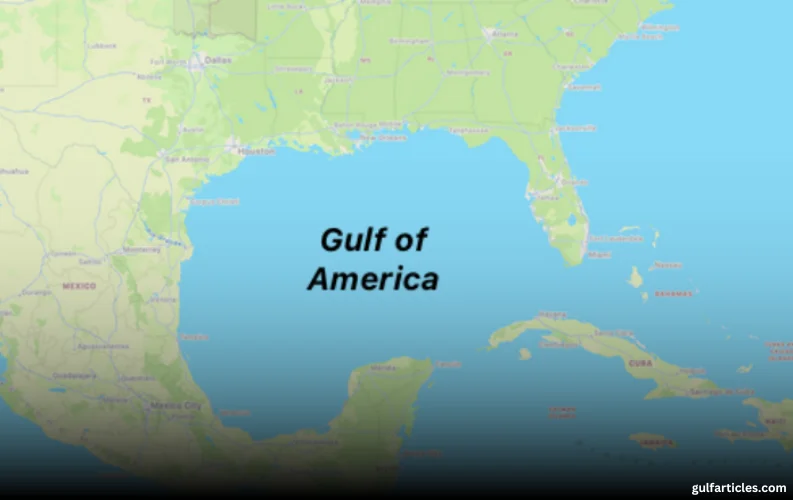
Tech giant Google has ignited a geopolitical debate after renaming the Gulf of Mexico to Gulf of America for users accessing its Maps platform from within the United States. The move, reportedly in compliance with an executive order issued by former U.S. President Donald Trump, has drawn sharp criticism from international leaders and historical scholars.
According to a blog post by Google, the change affects only U.S. users, while global users will continue to see both names.
“People using Maps in the U.S. will see ‘Gulf of America,’ and people in Mexico will see ‘Gulf of Mexico.’ Everyone else will see both names,” Google stated in its announcement.
Google’s Justification for the Name Change
Google defended its decision, stating that it aligns with the company’s policy of following official U.S. government geographic designations as defined by the Geographic Names Information System (GNIS).
This is not the first time the U.S. government has intervened in geographical nomenclature. In 2015, then-President Barack Obama officially recognized Alaska’s highest peak as Denali, reverting its name from Mt. McKinley to honor indigenous heritage. However, upon assuming office, Trump reversed this decision, reinstating the Mt. McKinley name.
International Backlash and Diplomatic Concerns
The renaming of the Gulf of Mexico has raised diplomatic concerns in Mexico, where officials condemned the decision as an attempt to rewrite historical and geographical facts.
Mexican President Claudia Sheinbaum responded with a satirical counterproposal, suggesting that Mexico could start referring to the United States as “Mexican America.” She referenced a historical map from before 1848, when Mexico lost a significant portion of its territory to the U.S. following the Mexican-American War.
“If historical renaming is now the norm, perhaps we should consider calling the U.S. ‘Mexican America,’” Sheinbaum remarked.
The move has also sparked debates among historians, who argue that renaming established geographic entities could set a precedent for politically motivated revisions.
Google’s Role in Political Name Changes
This is not the first time Google has been at the center of a geographic naming dispute. The company previously faced backlash over how it labeled disputed territories, including Taiwan, Crimea, and the South China Sea. Critics argue that Google, as a global platform, should remain neutral in politically sensitive matters.
As of now, the name change remains in effect for U.S. users, but experts predict that continued diplomatic pressure could force Google to revisit its decision.
Conclusion
While Google claims to follow official geographic names from government databases, the renaming of the Gulf of Mexico has sparked an international outcry. The controversy raises questions about the role of tech companies in political decisions and whether historical geography should be altered based on executive orders.
The world will be watching to see whether Google stands by its decision or if public and diplomatic pressure will lead to yet another reversal.













Comments 0
No comments yet. Be the first to share your thoughts.
Leave a comment
Your email is never published. All fields are required.