

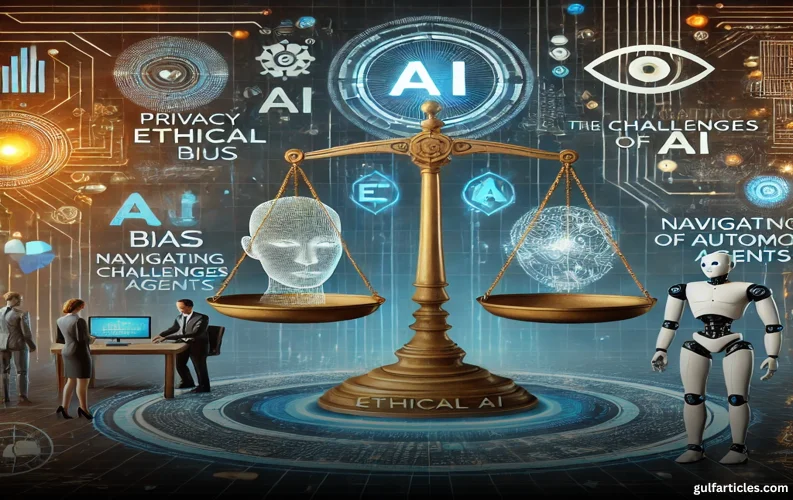
Artificial Intelligence (AI) is transforming the modern world, enabling automation, decision-making, and problem-solving across various industries. One of the most advanced aspects of AI is autonomous agents—systems that can act independently with minimal human intervention. From self-driving cars and AI-powered healthcare diagnostics to robotic assistants and financial trading bots, autonomous AI is reshaping industries by increasing efficiency and reducing human workload.
However, with great power comes great responsibility. The rise of AI-driven autonomy presents numerous ethical challenges that society must address to ensure these systems function fairly, transparently, and safely. Issues such as bias in AI decision-making, lack of accountability, privacy violations, security threats, and ethical dilemmas in life-critical situations demand urgent attention.
As renowned AI ethicist Shannon Vallor puts it,
"We are not just designing AI systems; we are designing the future of human values. Every algorithm, every decision, and every policy choice must reflect our deepest commitments to fairness, accountability, and the dignity of all people."
This article explores the ethical implications of AI-powered autonomous agents, the challenges they pose, and strategies for navigating these complex issues to ensure responsible AI development and deployment.
Understanding Autonomous AI Agents
Autonomous AI agents are intelligent systems that can perform tasks, learn from experience, and adapt to new situations without direct human control. These agents use machine learning, deep learning, reinforcement learning, and natural language processing (NLP) to understand their environments, make decisions, and take action.
Key Characteristics of Autonomous AI Agents
-
Decision-Making Ability – AI can analyze vast amounts of data and make informed decisions.
- Continuous Learning – AI adapts based on new experiences, improving over time.
- Minimal Human Supervision – Operates with little to no human intervention.
- Goal-Oriented Behavior – Works towards achieving predefined objectives.
- Interactivity – Can communicate with humans or other AI systems for collaboration.
Despite these advantages, AI autonomy raises significant ethical concerns that need to be addressed before these systems can be safely integrated into society.
Major Ethical Challenges of Autonomous AI
1. Accountability and Responsibility
One of the biggest ethical dilemmas in AI autonomy is assigning responsibility when things go wrong.
- If a self-driving car causes an accident, who is liable? The manufacturer, software developers, or the car owner?
- If an AI-driven medical diagnostic system makes a wrong prediction leading to a patient’s misdiagnosis, who should be held accountable?
- AI decision-making is often opaque, making it difficult to trace responsibility.
Solutions for Ethical Accountability:
-
Implement legal frameworks to define AI accountability.
- Require human oversight in high-risk AI applications.
- Introduce fail-safe mechanisms to allow human intervention.
As technology ethicist Wendell Wallach states,
"We need to ensure that AI systems are not just efficient and powerful, but also accountable and aligned with human values."
2. Bias and Fairness in AI Decision-Making
AI is only as unbiased as the data it is trained on. If training data contains historical biases, the AI system will replicate and amplify those biases.
- Biased hiring algorithms may favor certain races or genders.
- Facial recognition can be less accurate for people with darker skin tones.
- AI-driven loan approval systems may discriminate against minorities.
Solutions for AI Fairness:
-
Use diverse datasets when training AI models.
- Regularly conduct audits to detect and remove bias.
- Promote explainable AI (XAI) to increase transparency.
3. Privacy and Data Protection
Autonomous AI systems often rely on huge amounts of personal data, which raises concerns about privacy and security.
- AI assistants like Siri, Alexa, and Google Assistant continuously listen to users, leading to data privacy concerns.
- AI-powered surveillance systems can track people’s movements, raising ethical questions.
- Autonomous AI in finance and healthcare processes sensitive personal information, making it vulnerable to cyberattacks.
Solutions for Ethical Data Usage:
-
Strengthen data encryption and security measures.
- Ensure AI compliance with privacy laws (GDPR, HIPAA, etc.).
- Give users more control over their personal data.
As data privacy expert Shoshana Zuboff warns,
"Surveillance capitalism turns our personal data into raw material for profit. Ethical AI must prioritize privacy over unchecked data exploitation."
4. Transparency and Explainability
Many AI systems, especially deep learning models, function as black boxes, meaning their decision-making process is difficult to interpret.
- AI in criminal justice might predict the likelihood of a person reoffending, but how does it reach that decision?
- AI-driven medical diagnostics suggest treatments, but without clear explanations, doctors may struggle to trust the system.
Solutions for AI Transparency:
-
Develop explainable AI (XAI) models to make AI decisions clearer.
- Require AI systems to provide reasoning for their decisions.
- Establish industry-wide standards for AI interpretability.
5. Security Risks and AI Misuse
AI autonomy makes systems vulnerable to hacking and cyber threats. Malicious actors can exploit AI weaknesses to cause harm.
- Autonomous weapons powered by AI could be hacked and misused.
- AI-driven cybersecurity systems could be tricked into allowing security breaches.
- AI-generated deepfake technology can be used to spread misinformation.
Solutions for AI Security:
-
Implement strong cybersecurity protocols for AI.
- Conduct ethical hacking and penetration testing.
- Establish fail-safe mechanisms to prevent unauthorized AI control.
Cybersecurity researcher Bruce Schneier cautions,
"AI security isn’t just about preventing cyberattacks; it’s about ensuring AI systems don’t become threats themselves."
Building a Framework for Ethical AI
To ensure AI is developed ethically and responsibly, organizations, governments, and developers must adopt ethical guidelines and AI governance frameworks.
1. Ethical AI Development Practices
-
AI companies should follow ethical AI principles like fairness, accountability, and transparency (FAT guidelines).
- Use human-in-the-loop (HITL) models, where AI operates under human supervision in high-risk decisions.
2. Government Regulations and Policies
-
Governments must enforce AI-specific laws for sensitive industries like healthcare, finance, and defense.
- Ethical AI committees should oversee AI safety and compliance.
3. Corporate Responsibility in AI Ethics
-
Tech companies should commit to AI fairness and transparency.
- AI ethics impact assessments should be mandatory before launching AI products.
The Future of Ethical AI
The next decade will see increased AI regulations, ethical AI research, and stronger AI-human collaboration. Future advancements will likely include:
- AI laws and global regulations to prevent misuse.
- More explainable AI models to improve trust and understanding.
- Ethical AI certifications to ensure responsible AI development.
- Enhanced AI-human partnerships to combine AI efficiency with human oversight.
By prioritizing transparency, fairness, and accountability, we can harness AI’s potential while minimizing risks, ensuring a future where AI serves humanity ethically and responsibly.
You may also like:-














Comments 0
No comments yet. Be the first to share your thoughts.
Leave a comment
Your email is never published. All fields are required.