

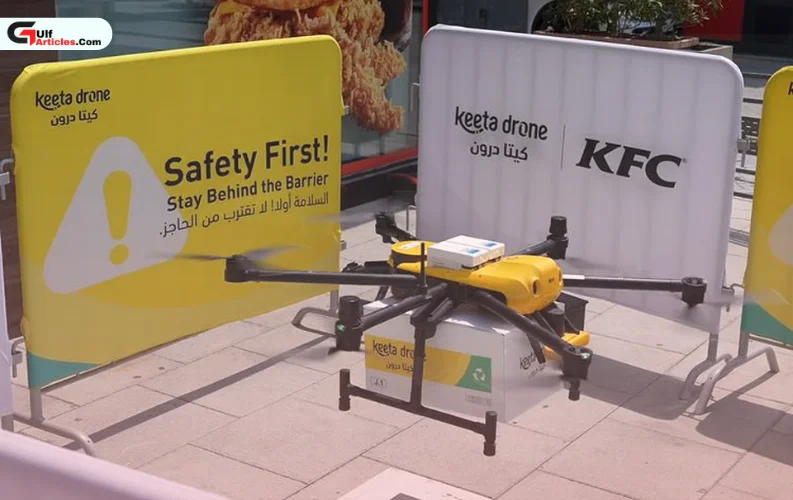
Drone delivery services could begin easing congestion in Dubai’s residential neighbourhoods during peak hours, according to a senior executive at Keeta Drone.
While the technology is not positioned as a replacement for traditional courier services, company officials say diverting a portion of short, high-frequency deliveries into the air may help reduce traffic pressure in densely populated communities.
Junwei Yang, General Manager of Keeta Drone, said the biggest impact would likely be felt in residential zones rather than on major highways.
“If drone delivery scaled meaningfully across dense urban clusters, it could help remove a portion of congestion from roads,” Yang said. He noted that delivery vehicles often cluster in neighbourhood streets at predictable times of day, contributing to localised traffic buildup.
Focus on Local Congestion
Yang explained that even shifting a modest share of short-haul deliveries could reduce vehicle concentration around housing communities, schools and public spaces.
Unlike ground vehicles, drones operate independently of road networks. They can fly directly between two points, including across water bodies and creeks that would otherwise require vehicles to take longer routes.
“By operating directly across water bodies, creeks, and delivering right into school campuses and public parks, without relying on road networks, drone delivery has the potential to reduce vehicle clustering and localised traffic buildup,” Yang said.
For residents, this could mean fewer delivery vans circulating through neighbourhood streets during rush hours, particularly in high-demand areas.
Supplement, Not Substitute
Keeta Drone emphasised that its services are designed to complement, not replace, existing delivery systems.
Yang stressed that drone logistics will act as a capacity supplement as demand for instant delivery continues to rise. “The goal is to serve as a capacity supplement, providing users with differentiated services and creating more service options,” he said.
He added that the expansion of drone operations could generate new employment opportunities in areas such as fleet management, maintenance and airspace coordination.
Looking ahead, Keeta estimates that 10 to 15 percent of global instant delivery orders could eventually be transported by air. However, Yang described this shift as a gradual evolution rather than a rapid disruption.
Faster Delivery During Rush Hours
One of the most immediate benefits for consumers is speed. Yang said most drone deliveries are currently completed within 15 to 30 minutes door to door, with merchant preparation time accounting for much of the overall wait.
Once dispatched, drones follow direct point-to-point air corridors, bypassing road traffic, accidents and diversions.
“During rush hours, that direct routing allows deliveries to avoid traffic jams and road diversions that slow down vehicles on the ground,” Yang said.
Dubai as a Testing Ground
Yang said Dubai offers a uniquely supportive environment for scaling drone delivery operations.
He cited progressive aviation oversight by the Dubai Civil Aviation Authority, as well as strong public-private coordination and well-defined zoning frameworks.
“The emirate combines strong public-private coordination with clear zoning and a controlled airspace environment,” Yang said, noting that this allows companies to pilot low-altitude logistics in live urban settings rather than isolated test areas.
Dubai’s technology-driven population and government backing for advanced mobility initiatives have also helped accelerate pilot programmes into real-world deployment.
Broader Implications
As Dubai continues to position itself as a global smart city hub, drone delivery could become part of a broader strategy to improve urban mobility and sustainability.
For residents, the impact may be less about futuristic innovation and more about practical benefits, shorter delivery times and fewer vehicles contributing to congestion on neighbourhood streets.
While widespread adoption will depend on regulatory expansion and operational scaling, Keeta Drone says the long-term potential lies in rebalancing how goods move across urban communities, shifting a portion of traffic from roads to the skies.