

Quick thinking by pilots and cabin crew helped save around 80 passengers after an engine failure struck an Arik Air Boeing 737-700 mid-air on February 11.
The aircraft, registered 5N-MJF and operating as Flight W3-740, had departed Murtala Muhammed International Airport for Port Harcourt when a loud bang was heard from the left engine shortly after takeoff.
According to the airline, cockpit instruments showed abnormal engine readings following the sound. Passengers also reported hearing a deafening noise, followed by strong vibrations inside the cabin.
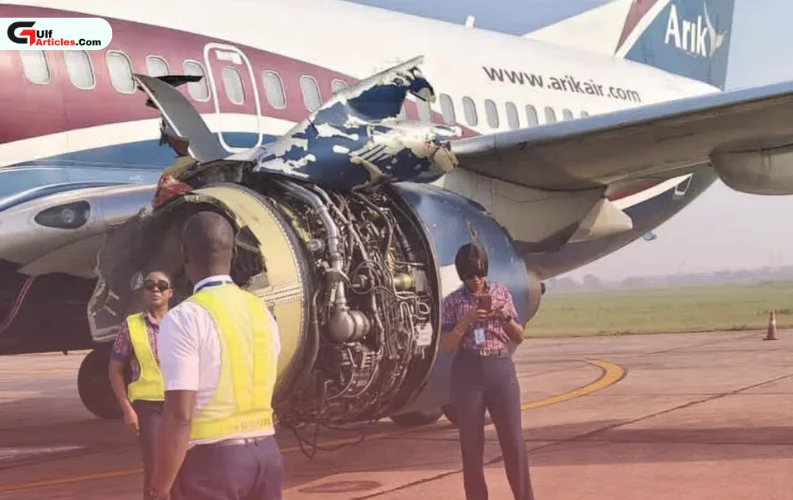
One passenger described the moment as frightening, saying the aircraft began shaking shortly after the loud bang. Videos later shared online showed visible damage to the engine cowling.
Emergency Procedures Activated
Instead of continuing to Port Harcourt, the pilots immediately shut down the affected engine and declared an emergency. They diverted the aircraft to Benin Airport, the nearest suitable airport.
The crew began descent around 7:38am local time and carried out a controlled single-engine landing at approximately 8:05am.
All passengers and crew disembarked safely. No injuries were reported.
Cabin Crew Maintained Calm
Cabin crew members played a key role in managing the situation inside the aircraft. They issued clear instructions, secured the cabin and reassured passengers while preparing for a possible emergency landing.
Their calm response helped prevent panic and allowed the pilots to focus fully on flying the aircraft safely.
Investigation Underway
The Nigerian Safety Investigation Bureau (NSIB) has launched a full investigation into the incident, classifying it as an “in-flight engine anomaly.”
Preliminary findings indicate significant damage to the left engine, including a missing inlet and torn cowling panels. Investigators have secured the aircraft and are reviewing flight data and cockpit voice recordings.
Arik Air praised the professionalism of its crew, stating that established safety procedures were followed at all times and that passenger safety remains its top priority.
The incident highlights how routine flights can quickly become emergencies, and how trained aviation professionals can prevent tragedy through swift action and strict adherence to safety protocols.