
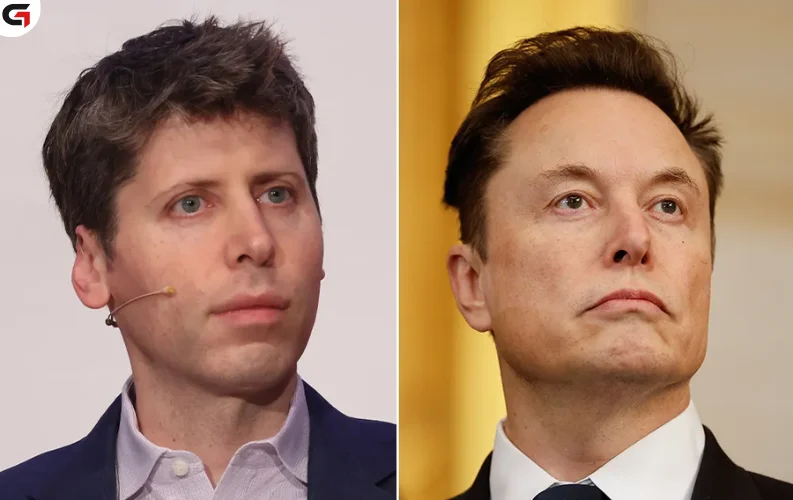
Ten years after Sam Altman and Elon Musk created OpenAI as a nonprofit meant to advance artificial intelligence for public benefit, the two founders now find themselves leading rival companies in one of the most valuable markets in tech history.
OpenAI has transformed from a small research lab into a $500 billion force, with global chipmakers and cloud providers, including Oracle, AMD, Broadcom and Nvidia, tying multi-year investment plans to its product roadmap. Its chatbot ChatGPT now attracts more than 800 million weekly users, a scale unmatched in the sector.
Musk, who split from OpenAI in 2018, is preparing a major fundraising round for his competing startup xAI. The company is expected to secure $15 billion in new financing at a valuation of about $230 billion, reflecting surging investor interest in next-generation AI systems.
The rivalry marks a sharp break from OpenAI’s founding vision. Musk helped launch the organization in 2015 with a pledge of $1 billion from early backers including Peter Thiel and Reid Hoffman, aiming to build AI without commercial pressure. But tensions emerged quickly, and Musk left the board as OpenAI shifted toward a hybrid nonprofit–for-profit structure to finance its growing ambitions.
That transition led to years of conflict. Musk sued OpenAI and Altman in 2024, accusing them of abandoning the original mission and aligning too closely with Microsoft, which remains the company’s largest partner. He also attempted earlier this year to acquire OpenAI outright for nearly $100 billion. OpenAI has since completed a recapitalization that leaves its nonprofit arm in control of its commercial operations, now organized under a public benefit corporation.
The competition extends beyond Musk. Former OpenAI executives Dario and Daniela Amodei left in 2020 to form Anthropic, which is attracting major investment from Microsoft and Nvidia and is now valued as high as $350 billion. Its Claude models are among the strongest challengers to OpenAI’s GPT line.
At the center of the race is a massive infrastructure buildout that could reshape the global tech industry. OpenAI has outlined spending plans exceeding $1.4 trillion to meet demand for data centers and advanced chips, a scale that dwarfs earlier tech investment cycles. Anthropic has commitments of around $100 billion, while Google and Meta are expanding their own systems at similar pace.
Whether those bets pay off remains uncertain. Analysts warn that companies are locking in extreme levels of capital expenditure based on rapid early growth that may not be sustainable. Oracle’s latest results, which triggered an 11% stock slide and dragged down other AI-related shares, underscored investor concerns about the strain of financing AI expansion.
Still, venture capitalists say the combination of AI models, custom hardware and hyperscale computing could produce trillion-dollar outcomes. That potential explains both the breakneck spending across the sector and the intense competition between long-time allies turned rivals.
OpenAI has moved into what Altman recently called “code red,” shifting resources to improve the speed and reliability of ChatGPT after Google’s Gemini 3 raised the competitive stakes. On Thursday, the company introduced ChatGPT-5.2, calling it its most capable reasoning model to date, and signed a three-year, $1 billion content and equity deal with Disney for its Sora video generator.
Altman told CNBC the company expects to return to normal operating mode by January, saying Gemini’s impact on user metrics was smaller than feared.
As OpenAI enters its second decade, its influence is now measured in trillions of dollars, a scale far removed from its nonprofit origins, and one that has turned its founders into direct competitors in the most consequential technology race of the era.